US Dollar
 Euro
Euro British Pound
 UAE Dirham
 Australian Dollar
 Singapore Dollar
Pre-Departure Forex Checklist: What to Sort before Your August Intake Flight (2026)

If you're reading this in the last week of July, you probably already know the feeling. The offer letter is framed somewhere, or should be. The flight is booked. And somewhere on your desk is a growing pile of things that all need to happen before you board a flight for an August or September start in the UK, the US, or Canada.
Most of that pile is money, in one form or another. First tuition installment. Forex card. Landing cash. Every one of those needs a specific order, done a specific way, or you end up fixing something from a different time zone in week two of a new country, which is a genuinely bad way to spend your first week of classes.
Here's a number worth sitting with first. Education remittances out of India actually fell close to 21 percent this year, down to about $2.31 billion, largely because of tighter US visa rules and a weaker job market for graduates abroad. Fewer families are sending kids overseas than last year. But the ones who are still going, and there are hundreds of thousands of them, are the ones who got their paperwork right. That's not a coincidence anymore. It's the entire game now; in a way it wasn't five years ago.
So here's the order to actually do this in, not just a list of things to remember.
Get the first tuition wire moving, correctly
Do this before anything else on this list. This isn't a regular bank transfer. Every outward remittance for education runs under the RBI's Liberalised Remittance Scheme, which caps what a resident individual can send abroad in a year and requires a specific form, the A2, filled out correctly at the point of transfer. Get the purpose code wrong on that form and your money can sit in limbo while your dealer sorts it out with the bank, which is not what you want two weeks before a deadline. If this is your first time doing this for a child or dependent heading abroad, it helps to read through what the actual process looks like end to end before you start.
Decide loan-funded or self-funded before you wire anything
This one decision changes your tax bill in a way most families don't realise until it's too late to fix. If the remittance is funded by an education loan from a recognised bank or a government scheme, there's no TCS collected at all, regardless of the amount. Fund it yourself, out of savings or a fixed deposit, and TCS kicks in at 2 percent on anything above ₹10 lakh in the financial year. That 2 percent isn't lost money; it's refundable when you file your return, but its money you won't see again for months. Know which bucket you're in before the transfer goes out, not after.
Sort your forex card next, from India, not after you land
This is the part people under think the most, mostly because a regular Indian debit or credit card technically does work abroad, so it feels like a solvable-later problem. It isn't, not really. Run a foreign transaction on your regular Indian card and you're usually looking at a markup of 3 to 3.5 percent on top of whatever exchange rate the card network applies that day, and that rate itself typically sits a percent or two worse than the interbank rate you'd get on a proper forex card. Add both together, and a family funding a full semester of living expenses on a regular card can lose tens of thousands of rupees to fees that never show up as a clean line item anywhere.
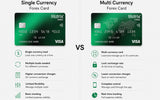
A multi-currency forex card loaded before you fly sidesteps the whole problem. Load it at the live interbank rate, no markup, and every foreign transaction for the rest of the year runs at that locked-in rate instead of whatever your bank feels like charging that week.
Work out landing cash separately from everything else
This is not the number you're wiring for tuition, and it shouldn't come out of the same mental bucket. You want enough physical cash on you, in the local currency, to cover the first two or three days without needing a card or an ATM that might not recognize an Indian bank yet. Enough for a taxi from the airport, a meal, incidentals, nothing more. Carrying too much cash is its own risk. Carrying too little means standing at an airport ATM at midnight hoping your card works on the first try.
A rough number is more useful than no number. For the UK, somewhere around £300 to £500 in cash for the first few days is typical, more if you're landing somewhere without easy card access to your accommodation deposit. For the US, $400 to $600 covers the same window, a bit more if you're arriving to an unfurnished room and need basics immediately. For Canada, CAD 400 to 600 does roughly the same job. None of these are hard rules. They're a starting point, and every city and living situation shifts the number a bit.
Budget for the first month separately from steady state
Every international student underestimates this one, every single year. A security deposit that's sometimes two or three months of rent upfront. Setting up a local SIM. Buying the basics for a room that came with nothing in it. None of this shows up in the university's official cost-of-attendance estimate, and all of it lands in your first ten days, right when you have the least local knowledge about where to spend less.
Carry the paperwork on you, not just in your email
You’re CoE or admission letter, the Form A2 copy from your remittance, proof of funds if your course requires it and your loan sanction letter if that's how you funded things. Immigration officers at the other end sometimes ask for these on arrival, and pulling up a PDF on a phone with patchy airport Wi-Fi is not the moment you want to be doing that. A printed folder takes ten minutes to put together and solves a problem you don't want to solve while jet-lagged. The full checklist of what an authorised dealer will actually ask for before releasing forex is worth a read if you haven't sorted this side yet.
Keep every receipt and form from this entire process
Not because you'll necessarily need them, but because the environment for outbound student money has shifted this year, and clean paperwork is what protects you if anything gets questioned later, whether that's a visa officer, a bank, or your own university's finance office.
If Australia is where you're actually headed
Your calendar looks different from everything above. The two big Australian intakes are February and July, not August, so the timing pressure you're feeling right now may not even apply to you yet. What does apply, and more than it used to, is documentation. Australia moved India to a stricter evidence tier at the start of this year, which means bank statements, proof of fund sources, and a clean paper trail behind every rupee now matter more than the total amount sitting in the account. We've written the full breakdown of exactly what that change means and what it asks for.
The most expensive mistake in this whole process
It's treating the forex card as optional because a regular debit card “should work fine.” It usually does work, technically. It just costs you quietly, every single time you tap it, for the entire duration of your course. A forex card is not a nice-to-have for a family already managing a six or seven figure spends on tuition and living costs. It's the cheapest change you can make in this whole checklist, and it takes about the same effort as everything else on this list combined.
If you're comparing forex cards right now and every result online seems to crown a different one as the best, that's not a coincidence either. A lot of that content is sponsored placement dressed up as a review. The two things actually worth checking on any card are whether the rate is genuinely the live interbank rate with zero markups, and which entity holds the RBI authorisation behind it, since some app-based cards are a layer on top of a license they don't hold themselves. We've written a straightforward comparison that skips the sponsored noise if you want the short version.
None of this is complicated once it's laid out in order. It just needs to happen in the right sequence, starting now rather than the week you fly, because every step here gets harder and more expensive the closer you get to departure.
Frequently asked questions
When should the first tuition wire actually go out?
As soon as your CoE or admission letter confirms the amount, ideally three to four weeks before the university's deadline, not the week of. The A2 paperwork and remittance processing take a few working days, and fixing a mistake from a different country and time zone is much harder than fixing it from home.
Should I load my forex card in India or after I land?
In India, before you fly. Loading it here locks in the interbank rate at the time you load, and it means you are not hunting for a working ATM or a card that recognises an Indian bank in your first jet-lagged days abroad.
How much landing cash do I actually need?
Enough for two to three days of essentials, not your whole first month. Roughly £300–500 for the UK, $400–600 for the US, and CAD 400–600 for Canada is typical, more if you are arriving to an unfurnished room and need basics immediately.
Does a loan-funded remittance really avoid TCS completely?
Yes, if the loan is from a recognised bank or a government education loan scheme and the sanction letter clearly states the funds are for study and living costs abroad. Self-funded remittances face 2 percent TCS above ₹10 lakh in a financial year, which is refundable when you file your return, not lost.
What documents should I carry printed, not just saved on my phone?
Your CoE or admission letter, the Form A2 copy from your remittance, proof of funds if your course requires it, and your loan sanction letter if that is how you funded things. Immigration officers sometimes ask for these on arrival, and a folder beats a PDF on patchy airport wifi.
Worth reading before you fly
A few things that pair well with this one:
● Forex for first-time international travellers: complete 2026 guide
● LRS limit explained: how much can you send abroad in a year
● Documents needed for a forex purchase in India, the full 2026 checklist
● Australia's Evidence Level 3: the financial proof Indian students now need
● How to claim a TCS refund on foreign remittance: ITR guide for 2026
Same-day delivery · RBI-authorised · No hidden charges
Get Free Callback →More from the Blog