


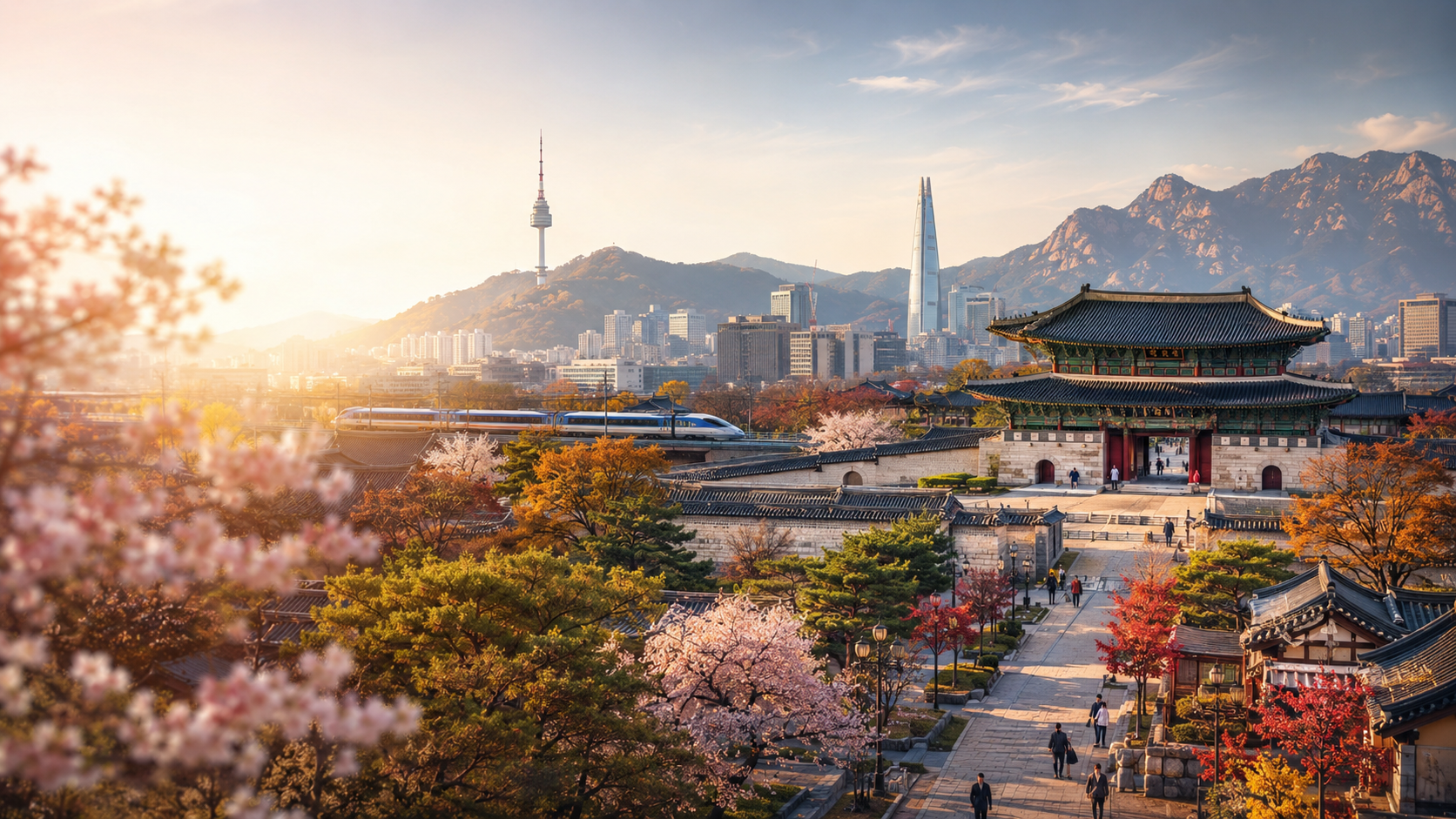
South Korea Travel Guide
A practical South Korea travel guide for international travellers: the Korean won, cards versus cash and T-money, K-ETA and the e-Arrival Card, Seoul and regional budgets, trains, VAT refunds and money tips.
South Korea money at a glance
Currency
South Korean won (KRW), symbol ₩. Common notes are ₩1,000, 5,000, 10,000 and 50,000.
Paying
Almost cashless. Cards, contactless and the T-money transit card cover almost everything; keep a little cash for markets and street food.
Cash for a week
KRW 100,000 to 200,000 is enough for many card-using visitors; top up at global ATMs.
Entry
Indians need a visa; the K-ETA is only for visa-waiver nationals. Jeju Island has its own visa waiver for direct international arrivals. Most visitors complete the free e-Arrival Card.
Daily budget
Roughly KRW 150,000 to 300,000 per person per day for a mid-range trip, higher in central Seoul and on Jeju.
Tax
VAT is 10%, included in prices; eligible visitors can claim a tourist refund on qualifying purchases at participating tax-free stores.
South Korea is one of the most card-friendly countries in Asia. Cards, contactless and the T-money transit card cover almost all spending, from the metro and buses to convenience stores. Cash still helps at traditional markets, some small restaurants and street food. Load T-money for transport (convenience-store top-ups are cash only), keep a modest won float, use global ATMs that accept foreign cards, and decline any card-terminal offer to convert to your home currency.
Best places to visit in South Korea
Most trips build from Seoul plus one or two of Busan, Jeju, Gyeongju or Jeonju. KTX high-speed rail connects the mainland cities quickly, and T-money works across transport nationwide. Each city now has its own guide with costs in Korean won and Indian rupees, what to see, and how to pay.
 Northwest
Seoul
First visits, palaces, food, shopping, museums and nightlife.
 Southeast coast
Busan
Beaches, seafood, markets, coastal temples and city views.
 South
SouthJeju Island
Volcanic landscapes, waterfalls, coastlines and road trips.
 Southeast
Gyeongju
Silla heritage, temples, tombs and cycling.
 Southwest
Jeonju
Hanok stays, traditional food and slower city travel.
| City | Region | Daily budget | Paying | In short |
|---|---|---|---|---|
| Seoul | Northwest | KRW 170,000-330,000 | Almost cashless; T-money | First visits, palaces, food, shopping, museums and nightlife. |
| Busan | Southeast coast | KRW 140,000-280,000 | Almost cashless; T-money | Beaches, seafood, markets, coastal temples and city views. |
| Jeju Island | South | KRW 160,000-330,000 | Card-first; car helpful | Volcanic landscapes, waterfalls, coastlines and road trips. |
| Gyeongju | Southeast | KRW 120,000-240,000 | Almost cashless | Silla heritage, temples, tombs and cycling. |
| Jeonju | Southwest | KRW 110,000-230,000 | Almost cashless | Hanok stays, traditional food and slower city travel. |
What things cost in South Korea
| Coffee | KRW 3,000 to 5,500 |
|---|---|
| Casual meal for one | KRW 8,000 to 15,000 |
| Sit-down dinner for two | KRW 30,000 to 70,000 |
| Seoul metro single | KRW 1,550 base fare with T-money |
| Mid-range hotel per night | KRW 90,000 to 200,000, higher in central Seoul |
| KTX Seoul to Busan | KRW 54,400 in standard class since 1 September 2026 |
| Jeju flight from Seoul | KRW 40,000 to 120,000 depending on date |
Budget roughly ₹9,300 to ₹18,600 per person per day on the ground, two sharing a room and excluding flights.
Budget ranges are editorial planning estimates based on typical mid-range travel costs reviewed in July 2026, for one person, two sharing a room, including accommodation but excluding international flights. Actual prices vary by city, season and choices.
Entry and tax to know
not required for visa-waiver travellers The temporary K-ETA exemption for currently covered visa-waiver countries is extended through 31 December 2026, so those travellers can enter without a K-ETA (applying still lets you skip the arrival card). Travellers who are not visa-waiver eligible, including Indian passport holders, need a visa; the K-ETA is not open to them. until 31 December 2026
Korea K-ETA (official) →10% VAT included in prices. Eligible visitors can claim a tourist refund on qualifying purchases at participating tax-free stores, either immediately in-store or at the airport on departure.
National Tax Service of Korea →Money in South Korea, in detail
South Korea uses the Korean won and is one of the most card-friendly countries in Asia: cards, contactless and the T-money card cover almost everything, so cash is mostly a backup for markets and street food. Indian passport holders need a visa, since the K-ETA is only open to visa-waiver nationals, and most visitors complete the free e-Arrival Card. Jeju Island is the exception, with its own visa waiver for direct international arrivals. Budget around KRW 150,000 to 300,000 per person per day for a mid-range trip. Carry most spending on a low-fee card with a backup, load T-money for transport, and keep a modest won float.
Understanding the won exchange rate
KRW exchange rates float, so compare the final customer rate after card foreign-transaction fees, ATM charges and any conversion offer rather than a headline number. Make sure your card handles KRW and choose KRW at terminals.
How much won to carry
KRW 100,000 to 200,000 is a practical starting float for card-using visitors. Most spending goes on a card or T-money; keep cash for traditional markets, street food and small vendors, and top up at global ATMs that accept foreign cards.
Cards, cash and T-money
South Korea is nearly cashless, but a cash-and-card mix plus T-money works best.
- T-money: a rechargeable transit card for metro, buses and many convenience stores; buy it at stations and convenience stores. Convenience-store top-ups are cash only and foreign cards cannot be tapped at the gates, so keep some won for it. Since March 2026, new machines at Seoul stations on Lines 1 to 8 also accept Visa and Mastercard.
- Cards: contactless is widely accepted; foreign cards work at most established businesses.
- Dynamic currency conversion: when a terminal offers KRW or your home currency, choose KRW to avoid an unfavourable processor rate.
The best ATM approach in South Korea
Use ATMs marked Global or with foreign-card logos, often at convenience stores, banks and transport hubs, as not every domestic ATM accepts foreign cards. Review the operator fee, withdraw a sensible amount rather than many small ones, and decline any home-currency conversion offer. Which machines carry the Global marking, the opening hours that catch out late arrivals, and the withdrawal limits are covered in our guide to using ATMs in South Korea with an Indian card.
Visa, K-ETA and the e-Arrival Card
Indian passport holders need a visa for South Korea. India is not on the visa-waiver list, and the K-ETA is only open to visa-waiver nationals, so it does not apply. Apply for a tourist visa, usually the C-3-9, through the Korea Visa Application Centre (KVAC) in India, and allow a couple of weeks before you book anything non-refundable. Travellers without a K-ETA complete the free official e-Arrival Card online within three days before arrival.
The exception is Jeju Island, which has its own 30-day visa waiver that India is eligible for, provided you fly into Jeju directly from abroad. Entry is at the immigration officer's discretion; the Jeju guide covers the conditions and the documents to carry.
Visa-waiver nationals are temporarily exempt from the K-ETA through 31 December 2026 (see the fees panel).
Getting around South Korea
Seoul, Busan, Daegu and other cities have extensive metro and bus networks, all payable with T-money; foreign cards cannot be tapped at the gates. KTX high-speed rail connects Seoul, Busan, Daegu and other mainland cities quickly; domestic flights reach Jeju. Use the same T-money card or device consistently, and book KTX and Jeju flights early for peak dates.
VAT and the tourist refund
South Korea applies a 10% VAT, included in displayed prices. Eligible foreign visitors can claim a tourist refund on qualifying purchases from participating tax-free stores, either as an immediate in-store deduction or at the airport on departure, when the minimum-spend and export conditions are met. Keep receipts and the goods available for inspection.
Cash declaration entering South Korea
Declare more than USD 10,000, or the equivalent in qualifying currency and payment instruments, on arrival. Declaring is a reporting requirement, not a penalty; keep exchange records where relevant.
South Korea money FAQs
Not with an Indian passport. The K-ETA is only for visa-waiver nationals, and India is not on that list, so Indians need a tourist visa, applied for through the Korea Visa Application Centre in India. The one exception is Jeju Island, which has its own visa waiver for direct international arrivals. Visa-waiver nationals are temporarily exempt from the K-ETA through 31 December 2026.
A free official online arrival declaration. Travellers who are not K-ETA holders generally complete it online within three days before arrival; keep the confirmation available for entry.
One of the most card-friendly countries in Asia. Cards, contactless and the T-money transit card cover almost everything; keep a little cash for markets and street food.
T-money is a rechargeable card for metro, buses and many convenience stores. It is very convenient; buy it at stations and convenience stores, top it up with cash (convenience-store top-ups are cash only), and use it consistently for transfers.
KRW 100,000 to 200,000 is enough for many card-using visitors; top up at global ATMs that accept foreign cards, and keep small notes for markets and street food.
Eligible foreign visitors can claim a refund of the 10% VAT on qualifying purchases at participating tax-free stores, either immediately in-store or at the airport on departure, when the conditions are met.
Declare more than USD 10,000, or the equivalent in qualifying currency and instruments, on arrival.
Usually yes at established businesses; contactless is widely accepted. Some small vendors and markets prefer cash, and not every domestic ATM accepts foreign cards, so use global ATMs.
Choose won (KRW). Home-currency billing (dynamic currency conversion) usually gives a poorer rate.
A low-foreign-transaction-fee card or multi-currency travel card supporting KRW, a backup card, T-money for transport, and a modest won float. Compare rates and fees before travel.
Cities have extensive metro and buses payable with T-money; KTX high-speed rail links mainland cities quickly, and flights reach Jeju. Book KTX and Jeju flights early for peak dates.
Spring (April to May) and autumn (September to November) have the most pleasant weather and scenery; summer is hot and humid with a rainy season, and winter is cold but good for snow and festivals.
Sort your Korean Won before you fly
Lock the rate, carry the right mix of cash and card, and know today’s KRW rate before you book.
Official sources reviewed
- Korea K-ETA (official) — K-ETA and temporary exemption
- Korea Immigration Service — e-Arrival Card and entry
- National Tax Service of Korea — VAT and tourist refund
- Korea Customs Service — Cash declaration (USD 10,000)
- Bank of Korea — Currency
- Korea Tourism Organization — General travel guidance and T-money
Last reviewed 28 September 2026 by Matrix Forex Editorial Team. Next review due 31 December 2026.
Plan your korean won money before you fly
Check today’s rate, load a multi-currency forex card, or speak to a Matrix Forex expert about the right travel-money mix.
RBI Authorised Dealer Category-II, Licence No. NDL-ADII-0023-2023 · Serving 3 lakh+ customers