Indian currency rank in world 2026 where the rupee stands

You've probably seen the headline. The rupee hit an all-time low against the dollar in 2026, and somewhere in the scroll, a bigger question showed up. Not just "how weak is the rupee against the dollar," but "where does the rupee actually rank against everything else." Is it near the bottom of the pile globally? Middle of the pack? Does "weak against the dollar" even mean "weak, period"?
It's a fair question, and most answers online skip past it. Search for the ranking of Indian currency in the world and you'll get a dozen listicles of the same ten currencies, usually Kuwaiti dinar at the top, usually with no real explanation of what "rank" is even measuring or where India fits into the picture beyond a passing mention.
So here's the straight version. Where the rupee sits today, measured properly. Why 2026 specifically changed its story. And what any of this actually means if you're the one converting rupees into something else, whether that's for a trip, a tuition fee, or money you're sending to family abroad.

A global comparison of major currencies by the USD value of one unit, with the Indian Rupee highlighted.
What "ranking" a currency even means
Before the numbers, one thing has to be said plainly, because it trips up almost every version of this question online: a currency's rank by unit value has nothing to do with how strong its economy is.
There are two completely different things people mean when they ask about currency "strength," and conflating them is where most confusion starts.
Unit value is simply how many of Currency A you get for one of Currency B. This is what most "ranking" lists measure, and it's almost entirely arbitrary. It depends on how a currency was originally denominated, not on the size or health of the economy behind it. The Kuwaiti dinar sits near the top of every ranking not because Kuwait's economy dwarfs the world's largest ones (it doesn't, not by a wide margin), but because when the dinar was introduced in 1961 to replace the old Gulf rupee, it was set at a high base value and never redenominated since.
Economic strength is a completely different measure: GDP, trade balance, inflation, reserves, how a currency is actually used in global trade. India's GDP is the world's fourth or fifth largest depending on the year and measure. Japan's yen trades at over 140 to the dollar, and nobody credible argues Japan's economy is weak because of it. The Vietnamese dong trades at roughly 26,000 to the dollar, and Vietnam's economy has been one of Asia's fastest-growing for a decade straight.
So when the question is "ranking of Indian currency in the world," what's actually being asked, in almost every case, is the first one: where does one rupee land against everything else, purely by unit value. That's the honest, useful answer this piece gives. Just worth knowing upfront that it's not a scorecard for India's economy.
Where the rupee sits today: the real numbers
As of August 19, 2026, one US dollar buys roughly ₹95.7 to ₹95.8. That's the number most people already know. Here's the fuller picture, currencies stronger than the rupee by unit value on one side, currencies weaker on the other.

The Indian Rupee sits at the ₹1 reference point, with major global currencies compared by the INR value of one unit as of August 19, 2026.
|
Currency |
1 unit = approx. ₹ |
Where it stands |
|
Kuwaiti Dinar (KWD) |
₹310.47 |
World's highest-value currency by unit |
|
Bahraini Dinar (BHD) |
₹253-254 |
2nd highest |
|
Omani Rial (OMR) |
₹248-250 |
3rd highest |
|
British Pound (GBP) |
₹129.7-130.2 |
Major reserve currency |
|
Euro (EUR) |
₹110.9-111.5 |
2nd most-traded currency globally |
|
Swiss Franc (CHF) |
₹117-118 |
Traditional safe-haven currency |
|
US Dollar (USD) |
₹95.7-95.8 |
World's primary reserve currency |
|
Indian Rupee (INR) |
₹1 |
This is us |
|
Indonesian Rupiah (IDR) |
₹0.0054 (1 INR ≈ 185 IDR) |
Weaker than INR by unit |
|
Vietnamese Dong (VND) |
₹0.00366 (1 INR ≈ 273-274 VND) |
Weaker than INR by unit |
The pattern is clear once it's laid out this way. The rupee sits solidly in the middle of the global table. It's a long way from the Gulf dinars and rials at the top (the Kuwaiti dinar's climb to the top spot has its own story), and it's well ahead of a large group of Southeast Asian and other currencies whose unit values run into the thousands or tens of thousands per dollar. Neither extreme is where India actually is. If you're buying pounds or euros specifically, both currency guides break down the history and the practical buying details in more depth than a comparison table can.
The list every ranking site skips: where the rupee is stronger
This is the part most "top 10 highest currencies" lists never get to, because it's less flashy than another Kuwaiti dinar headline. But it's arguably more useful, since it flips the framing: instead of "how weak is India," it's "where does India's money actually go further."
The rupee is stronger, unit for unit, than the currencies of dozens of countries, including some genuinely major travel and remittance destinations for Indians:
• Indonesia (IDR): a single rupee buys roughly 185 rupiah
• Vietnam (VND): roughly 273-274 dong per rupee, though ATM fees there vary sharply by bank, so which machine you use matters more than the exchange rate itself
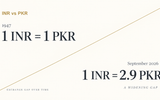
• Sri Lanka, Nepal, and several other South Asian neighbours, where INR either buys a favourable ratio outright or, in Nepal's case, is pegged directly to the Indian rupee at a fixed rate. Pakistan is one of those neighbours: a single rupee buys about 2.9 Pakistani rupees, though the Pakistani rupee was worth more than India's three separate times since 1947, as our Indian rupee vs Pakistani rupee history shows
• Several African and Latin American currencies, where high nominal inflation over decades has pushed unit values into very large numbers relative to a single rupee
None of this means those economies are worse off than India's. The Vietnamese dong sitting at 26,000-something to the dollar is a function of how the currency was denominated after reunification in 1978, not a verdict on Vietnam's growth, which has consistently outpaced most of the region. The comparison is genuinely informative for one thing only: if you're planning to spend rupees converted into one of these currencies, your money stretches further in raw unit terms than it does converting into a dinar or a euro. That's a real, practical fact. It's just not an economic report card.
Why 2026 is different: the rupee's roughest year in over a decade
Here's the part a static ranking table misses entirely, and it's the reason this question is worth a fresh answer right now rather than a recycled one from a year ago.
2026 has been the rupee's most volatile year in recent memory, and by several measures, its worst-performing year in over a decade. The currency touched an all-time low of roughly ₹96.84 to the dollar on May 20, 2026, driven by a combination of factors that all hit at once: a sharp spike in Brent crude tied to conflict around the Strait of Hormuz, sustained foreign portfolio investor outflows from Indian equities and debt, and broad dollar strength as the US Federal Reserve held rates higher for longer. India imports the overwhelming majority of its crude oil, priced in dollars, so an oil price spike translates almost directly into more rupees needed to cover the same import bill.

USD/INR rose from around ₹89.9 in January to a 2026 peak of ₹96.84 on May 20, before easing to around ₹95.5–₹95.8 by August.
By multiple measures through 2026, the rupee has been Asia's worst-performing major currency for the year, a title it's held on and off through several stretches of the year as the Indonesian rupiah, the Philippine peso, and others took turns under similar pressure. Separately, credit rating agency Moody's flagged in its 2025 corporate outlook that the rupee had depreciated roughly 20 percent over the preceding five years, among the weaker showings in South and Southeast Asia over that stretch, a trend that continued through the pressures of 2026.
None of this changes the rupee's position on a static "highest currency" ranking table, since that ranking barely moves year to year. What it does change is the story behind the number: 2026 is the year the rupee's weakness against the dollar became genuine, sustained news, not just a routine few-paise slide.
By mid-August 2026, the rupee had recovered somewhat from May's all-time low, trading around ₹95.5-95.8, helped along by RBI intervention and a temporary easing in oil prices. Whether that holds through the rest of the year depends heavily on the same two variables that drove the slide in the first place: where oil prices settle, and how the dollar performs globally.
Common mistakes people make reading currency rankings
Assuming a high unit value means a strong economy. The single most common mix-up. The Kuwaiti dinar being worth over 300 rupees says nothing about Kuwait's GDP relative to India's; it says something about how the dinar was denominated in 1961.
Assuming "weak against the dollar" means "weak against everything." The rupee weakening against USD in 2026 doesn't automatically mean it weakened against, say, the Indonesian rupiah or the Vietnamese dong over the same period. Currency pairs move independently; check the specific pair that matters for your situation rather than assuming a dollar headline applies universally.
Confusing a currency ranking with a travel-cost ranking. A currency being "lower" than the rupee doesn't automatically make a country cheap to visit. Local prices, not just the exchange rate, decide what a trip actually costs. Vietnam's dong trades at a huge unit discount to the rupee, and Vietnam genuinely is an affordable destination for Indian travellers, but that's a coincidence of both facts being true together, not one causing the other.
Treating an old ranking as current. Currency rankings by unit value change slowly, but the why behind a currency's current level, especially the rupee's, moves fast. A "strongest currencies" page from two years ago will still list roughly the same top ten by unit value; it almost certainly won't mention that 2026 was the year the rupee hit its all-time low against the dollar.
What this actually means if you're converting rupees right now
If you're reading this because you're about to buy forex, whether for a trip, a semester abroad, or sending money to family, the ranking itself is mostly a curiosity. What matters practically is the specific pair you're converting, and getting that conversion at a rate close to the live interbank rate rather than losing a chunk of it to markup.
A weaker rupee against the dollar in 2026 means the same trip, tuition fee, or remittance in dollar terms now costs more in rupees than it would have a year or two ago. That's true whether you're booking a US holiday, paying a UK university, or sending money to a child studying in Australia. It's also exactly the kind of gap where a wide bank markup or an airport counter's poor rate compounds an already-costlier conversion. If you're sending money abroad specifically, it's also worth knowing the annual ceiling on how much you can remit: every resident individual's outward transfers are capped under RBI's LRS limit, currently USD 250,000 per financial year across all purposes combined.
Matrix Forex is an RBI-authorised Category II forex dealer, and rates on currency pages and remittance transfers track the live interbank rate with no added markup. If you're converting for travel, tuition, or a remittance and want to see exactly where the rupee stands against the currency you actually need, the live rates page shows current pricing for over 40 currencies, updated continuously rather than pulled from a static table.
Frequently asked questions
What is India's rank among world currencies?
By unit value against major currencies, the Indian rupee sits in the middle of the global table. It's well below the highest-value currencies (Kuwaiti dinar, Bahraini dinar, Omani rial, along with the pound, euro, and Swiss franc), but ahead of dozens of others, including the Indonesian rupiah, Vietnamese dong, and several African and Latin American currencies. There is no single official numbered "rank" published by any central authority; unit-value comparisons like this one are the closest practical answer.
Which currency has the highest value in the world?
The Kuwaiti dinar (KWD) currently holds the highest unit value of any actively circulated currency, trading at roughly ₹310 as of August 2026. It's followed by the Bahraini dinar and the Omani rial, both Gulf currencies backed by strong oil-export economies and, in the dinar's case, a currency basket peg rather than a single-currency peg.
Is the Indian rupee the weakest currency in the world?
No. That's a common misconception driven by dollar-focused headlines. Several dozen currencies have a lower unit value than the rupee, including the Vietnamese dong, the Indonesian rupiah, and various currencies affected by long-term high inflation. The rupee's weakness in 2026 has been specifically against the US dollar and a handful of other strong currencies, not against the global field as a whole.
Which countries have currency lower in value than the Indian rupee?
Indonesia, Vietnam, several other Southeast Asian nations, and a number of countries in Africa and Latin America where sustained inflation has pushed unit values well below the rupee's. Nepal's currency is pegged directly to the rupee at a fixed rate, so it isn't a floating comparison in the same sense.
Why did the rupee hit an all-time low in 2026?
A combination of a sharp oil price spike tied to Strait of Hormuz tensions (India imports the large majority of its crude, priced in dollars), sustained foreign portfolio investor outflows from Indian markets, and broad US dollar strength as the Federal Reserve held rates elevated. The rupee touched roughly ₹96.84 to the dollar on May 20, 2026, before partially recovering through the summer.
Does a weaker rupee mean India's economy is doing badly?
Not directly, and this is worth separating clearly. Currency value and economic size or growth are related but distinct measures. India's GDP remains among the world's largest, and a weaker rupee against the dollar specifically reflects capital flows, oil prices, and dollar strength more than it reflects the underlying size or output of India's economy.
Same-day delivery · RBI-authorised · No hidden charges
Get Free Callback →