What Is a Cross-Currency Fee on a Forex Card, and How to Avoid It

A cross-currency fee is the charge a forex card adds when you spend in a currency that is not loaded on the card. Suppose a card holds only US dollars and a payment goes through in euros.
The card has to convert dollars into euros to settle it, and it takes a small percentage for the conversion. That percentage goes by several names: the cross-currency fee, the cross-currency markup, the currency conversion fee, or, on bank cards, the foreign transaction fee. It is easy to miss, because it sits inside the exchange rate rather than showing up as a separate line on the receipt.
This guide explains what the fee is, how it is worked out, when it applies, and the steps that keep it off your bill. The short answer is that the fee appears only when the card has to convert, so loading the currencies you will actually spend keeps it away.
What is a cross-currency fee?
A cross-currency fee is a charge applied when a forex card converts money from a currency it holds into a currency it does not, so a foreign payment can go through.
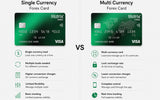
A forex card works like a set of separate wallets, with one currency in each. You choose which currencies to load before you travel and put an amount into each one.
Pay in a currency you have loaded, and the money comes straight from that wallet at the rate you fixed at loading, with nothing converted. The fee appears only when you spend in a currency that has no wallet on the card.
The card cannot pay in a currency it does not hold, so it takes one you do hold, usually US dollars, converts it into the currency you are spending, and charges a percentage for the conversion. The amount that leaves your card is a little more than the live market value of the purchase, and that gap is the fee.
This is separate from the rate you locked in at loading. The loading rate protects the currencies you loaded. It does nothing for a currency you did not load, because that spending is converted fresh at the moment of purchase.

Why does a forex card charge a cross-currency fee?
The fee is not arbitrary. A forex card issuer buys foreign currency in bulk and loads it onto your card at the rate of the day. Spend a currency that is already on the card and the issuer has nothing more to do, so nothing extra is charged. Spend a currency that is not loaded and the issuer has to arrange that currency for you on the spot.
That last-minute conversion carries a cost, and the markup covers it and adds a margin. This is why the fee cannot be waived once a conversion is needed, and why loading in advance is the only real way around it.
Ordinary bank cards work on the same principle. A bank that sells foreign currency to a customer builds a markup into the rate rather than showing it as a separate charge. Across the market, that markup commonly runs from about 2 to 5 percent of the amount converted.
How much is a cross-currency fee?
A cross-currency fee is usually a percentage of the transaction, and on most cards it sits somewhere between 2 and 5 percent.
The exact figure depends on the issuer, and it has two parts that stack up. The first is the conversion rate the issuer uses, which is often a little weaker than the live interbank rate that banks trade at among themselves.
The second is the markup percentage added on top. On ₹50,000 of foreign spending, a fee in that band works out to between ₹1,000 and ₹2,500, and on a longer trip with several such payments the total climbs quickly.
When does a cross-currency fee apply?
A cross-currency fee applies whenever the card has to convert into the currency you are spending, rather than paying from a wallet you have already loaded. A few common situations bring it on.
The first is a multi-country trip with only one currency loaded. Load euros for a Europe trip, then spend a few days in London, and every pound is converted from euros with the fee on each payment. Loading both currencies before you leave avoids it.
The second is spending in a currency the card does not support at all. Here the card often converts twice, moving from your loaded currency into US dollars and then into the local currency, with a markup possible at each step. Double conversion is the most expensive way to pay.
Online shopping is a third. Buy from a foreign website that bills you in a currency you have not loaded, and the card converts to cover it, with the fee applied just as in a shop.
This also explains why an ordinary bank debit card is costly abroad. You can use an Indian debit card abroad wherever the network is accepted, and you can use a bank card overseas in general, but both are tied to your rupee account.
Every foreign swipe converts rupees into the local currency and adds a markup, which on a bank statement is often called the foreign transaction fee. That is exactly the cost a forex card removes when you load the right currency.
Dynamic currency conversion: a related cost
Dynamic currency conversion, or DCC, adds to the same problem from a different direction. At a shop counter or an ATM abroad, the machine may offer to charge you in rupees instead of the local currency.
It looks helpful, because the price appears in a currency you recognise. The catch is that the merchant or the ATM operator sets that conversion rate, and it is usually a poor one with a markup of its own on top. The safe choice is to be charged in the local currency every time, and to let your card handle any conversion, or better still spend from a wallet you have already loaded so no conversion happens at all.
A worked example: loading the wrong currency
Numbers make the cost easy to picture. Take a two-week trip across Europe and the United Kingdom on a card loaded only with euros. In the United Kingdom the traveller spends the equivalent of ₹80,000 in pounds. Because the card holds no pounds, every payment converts from euros, and at a 3 percent cross-currency markup that adds ₹2,400.
Then a hotel in a third country bills the equivalent of ₹40,000 in a currency the card does not support. That amount converts twice, euros into US dollars and US dollars into the local currency, and at a combined markup of about 4 percent across the two conversions it adds ₹1,600. The two together cost ₹4,000, and none of it bought anything extra. Loading pounds alongside euros, and planning ahead for the third currency, would have kept almost all of it in the budget.
Cross-currency fees and the other forex card charges
A cross-currency fee is only one of several charges a forex card can carry, and it helps to tell it apart from the rest. An issuance fee is a one-time charge for the card itself. A reload fee may apply each time you add money.
An ATM withdrawal fee is charged per cash withdrawal abroad. An inactivity or closure fee can apply if the card sits unused for a long period, or when you close it and withdraw the balance. The cross-currency fee is different from all of these, because only spending in a currency you have not loaded triggers it. A clear fee schedule lists each charge as a separate, named figure, so you can see exactly what you are agreeing to.
Do debit and credit cards have a cross-currency fee?
A forex card loaded with the right currency does not trigger a cross-currency fee, because nothing is converted at the point of sale. Debit cards and credit cards work differently. Each is tied to your rupee account or credit line, so every foreign payment is converted from rupees and a markup is applied to each transaction.
That conversion markup does the same job as the cross-currency fee, except it lands on every swipe rather than only on currencies you have not loaded. Loading the right currency on a forex card is what avoids it.
|
Card type |
Converts from |
Typical markup |
Cross-currency fee |
|---|---|---|---|
|
Forex card, right currency loaded |
Nothing, pays from the wallet |
None at point of sale |
No |
|
Forex card, currency not loaded |
A loaded currency, often US dollars |
About 2% to 5% |
Yes |
|
Debit card |
Your rupee account |
About 2% to 5% (foreign transaction fee) |
Yes, every swipe |
|
Credit card |
Your rupee credit line |
About 2% to 5% (foreign transaction fee) |
Yes, every swipe |
How to avoid cross-currency charges on a forex card
Load the right currency for every destination
Match the currencies on the card to the countries on your itinerary, and load them before you leave. If a trip covers three countries, load all three. When the card can pay from a matching wallet, no conversion happens and the fee never starts.
Use a multi-currency card for multi-country trips
A multi-currency card holds several currencies at once, which suits travel that crosses borders. When you compare multi-currency cards, or a prepaid travel card, check that it supports every currency you will need on the trip. A card that holds the wrong currencies loses its advantage, because spending outside its wallets brings the charge straight back.
Always choose the local currency
When a counter or an ATM abroad offers to bill you in rupees, decline and choose the local currency. As covered above, the rate the merchant or machine sets is usually worse than your card's.
Pay online in a currency you have loaded
For foreign websites, pay in a currency that sits in one of your wallets wherever the site allows it. If a site bills only in a currency you have not loaded, expect the conversion fee to apply.
Keep some local cash for the gaps
Small payments, tips, and the occasional place that does not take cards are easier with a little local cash. It also stops you spending an unloaded currency on the card and triggering a conversion for a tiny amount.
Check the markup before you choose a card
Before you settle on a card, read its fee schedule. Anyone comparing forex cards should look past the headline marketing and check three details: which currencies the card supports, the cross-currency markup percentage, and whether the conversion rate is close to the interbank rate or marked up. Those three decide what a foreign payment actually costs.
In short
A cross-currency fee is avoidable. It exists only because a card has to convert into a currency it does not hold, so the way to stop it is to make sure the card holds what you plan to spend. Load the currencies that match your trip before you go, and turn down dynamic currency conversion when a counter or an ATM offers it. Read a card's fee schedule before you commit, so the markup percentage and the supported currencies hold no surprises. With those habits in place, most of the conversion cost that quietly eats into a travel budget never appears in the first place.
Frequently asked questions
What is a cross-currency fee on a forex card?
A cross-currency fee is the charge a forex card adds when you spend in a currency it is not loaded with, because the card has to convert from a currency you do hold to complete the payment. It is usually a percentage of the amount spent.
How much is the cross-currency fee?
The cross-currency fee is typically a percentage of the transaction, on most cards between 2 and 5 percent, though the exact figure depends on the issuer. On ₹50,000 of spending, that works out to between ₹1,000 and ₹2,500 in extra charges.
Is a cross-currency fee the same as a foreign transaction fee?
In practice they describe the same cost, a charge for converting your payment into a currency your card does not already hold. Banks usually call it a foreign transaction fee on debit and credit cards, while forex cards tend to call it a cross-currency fee or cross-currency markup.
Can you use a debit card abroad?
Yes, you can use an Indian debit card abroad wherever the card network is accepted. Every foreign transaction is converted from your rupee account with a markup added, though, which makes it an expensive way to spend day to day.
Can I use my bank card overseas?
Yes, most Indian bank cards work overseas on international networks. They convert each payment from rupees and apply a markup, so they cost more than a forex card loaded with the local currency.
Is it better to use a credit or debit card abroad?
Both a credit card and a debit card convert foreign spending from rupees and add a markup, so neither avoids the conversion cost the way a well-loaded forex card does. Between the two, the better choice depends on your bank's fees and on how you plan to repay.
Does loading the right currency remove the fee completely?
Yes. When you spend from a wallet that already holds the currency you are paying in, no conversion takes place, so no cross-currency fee applies. The fee only appears when the card has to convert.
How do I avoid cross-currency charges on a forex card?
The most reliable way to avoid cross-currency charges is to load every currency you will spend before you travel, decline dynamic currency conversion at counters and ATMs, and keep a small amount of local cash for places that would force a conversion.
How do you choose the best forex card in India to avoid cross-currency charges?
The best forex card in India for this purpose, or the best prepaid card for overseas travel, is the one that supports every currency you will spend, charges a low cross-currency markup, and converts at a rate close to the interbank rate. For a multi-country trip, the best multi-currency card is simply the one that holds every currency on your route, so no payment has to be converted.
Can you get foreign currency at the airport?
Yes, airport counters do exchange currency, but their rates are often weaker than ordering currency in advance. For card spending, the airport makes no difference to the cross-currency fee, which depends only on whether the currency you are spending is loaded on the card.
Same-day delivery · RBI-authorised · No hidden charges
Get Free Callback →More from the Blog