US Dollar
 Euro
Euro British Pound
 UAE Dirham
 Australian Dollar
 Singapore Dollar
Which Sri Lankan ATMs Charge Your Indian Card, and Which Do Not

ATMs in Sri Lanka are the rare case where the machine you pick matters more than the bank you left home with.
Withdraw LKR 40,000 from a Sampath Bank ATM in Colombo and you pay the machine's own fee on top of everything your Indian bank charges. Walk to a People's Bank or Bank of Ceylon machine and that fee can disappear entirely, for the same cash, on the same card, ten minutes apart.
That single choice is worth more than any card comparison. This guide covers which Sri Lankan banks charge foreign cards and which do not, what a withdrawal actually costs once your Indian bank has taken its cut, the withdrawal limits that catch people out, and the one screen that quietly adds a markup you never agreed to.

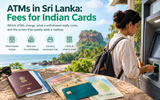
What ATMs in Sri Lanka charge an Indian debit card
There are two sides to the bill and they never appear on the same screen.
|
# |
Charge |
Who charges it |
Typical size |
Shown on the ATM screen? |
|
1 |
Foreign currency markup |
Your Indian bank |
Around 3.5% of the amount |
No |
|
2 |
International ATM withdrawal fee |
Your Indian bank |
₹100 to ₹125 per withdrawal |
No |
|
3 |
GST on those charges |
Government of India |
18% on the bank's fees |
No |
|
4 |
Local ATM fee |
The Sri Lankan bank that owns the machine |
LKR 0 to about LKR 500 |
Yes, usually |
Charges 1 to 3 travel with your card and follow you to every machine on the island. Most large Indian banks apply some combination of a currency markup and a flat international ATM fee, though the exact numbers depend on your bank, your card variant and your account type. Check your own schedule of charges before you fly.
Charge 4 is the one you can actually do something about, and in Sri Lanka the spread between machines is unusually wide.
Which Sri Lankan banks charge foreign cards
This is the part worth screenshotting before you travel.
|
Sri Lankan bank |
Fee on a foreign card |
|
Bank of Ceylon (BOC) |
Often none, depending on the card |
|
Nations Trust Bank |
Often none, depending on the card |
|
NSB Bank |
Often none, depending on the card |
|
Amana Bank |
Often none, depending on the card |
|
HSBC Sri Lanka |
Often none, depending on the card |
|
Standard Chartered |
Often none, depending on the card |
|
People's Bank |
Often none, depending on the card |
|
Union Bank |
Often none, depending on the card |
|
Sampath Bank |
Charges foreign cards |
|
Hatton National Bank (HNB) |
Charges foreign cards |
|
Seylan Bank |
Charges foreign cards |
|
NDB Bank |
Charges foreign cards |
|
Cargills Bank |
Charges foreign cards |
Reported local fees cluster around LKR 300 to LKR 500 per withdrawal, with some sources putting the range wider at LKR 200 to LKR 1,000. Treat the table as a strong steer rather than a guarantee: fee policies change, and whether a particular machine charges can depend on which network your card runs on. The machine has to display its own fee before you confirm, so the reliable move is to read that screen and cancel if you do not like it. Cancelling costs nothing.
Practically: look for a People's Bank or Bank of Ceylon machine first. They are the two big state banks, their ATMs are everywhere including small towns and the hill country, and both are frequently free on foreign cards. Nations Trust, NSB and Amana are the next best bets in the cities.
What LKR 40,000 actually costs you
The Sri Lankan rupee sits around ₹0.2885 to the Indian rupee at the mid-market rate as of early September 2026. That is the benchmark below. It is not a rate any retailer sells at, and it moves daily.
LKR 40,000 is a sensible first withdrawal: enough for several days of tuk-tuks, meals and train tickets without walking around with a brick of cash.
|
Line |
Calculation |
Amount |
|
The rupees themselves, at mid-market |
LKR 40,000 × ₹0.2885 |
₹11,540 |
|
Bank foreign currency markup |
3.5% of ₹11,540 |
₹404 |
|
International ATM fee |
flat, per withdrawal |
₹125 |
|
GST |
18% of (₹404 + ₹125) |
₹95 |
|
Local ATM fee |
LKR 400 at ₹0.2885 |
₹115 |
|
Total debited |
|
₹12,280 |
|
Cost above the mid-market rate |
|
₹740, or 6.41% |
The mid-market rate is indicative. The fee figures are assumptions drawn from published Indian bank schedules, and the local fee assumes a machine that charges one. On a fee-free machine, a People's Bank or BOC one for instance, the last line drops out and the total falls to about ₹12,164, or 5.41% over mid-market.
Now the mistake that costs the most. Four withdrawals of LKR 10,000 instead of one of LKR 40,000 does not change the percentage charges at all, but it multiplies the flat ones. That is four lots of ₹125 and four local fees instead of one, adding roughly ₹790 to exactly the same amount of cash.
Withdraw fewer, larger amounts. Splitting that one withdrawal into four roughly doubles what it costs you above the mid-market rate, from about ₹740 to ₹1,530, for exactly the same cash in hand.
The withdrawal limit that catches Indian travellers out
Sri Lankan per-transaction limits are lower than Indian travellers expect. Commercial Bank and Sampath Bank allow up to around LKR 100,000 per transaction on some machines, but plenty of ATMs cap a single withdrawal well below that, and some cap at LKR 20,000 to LKR 40,000.
This interacts badly with the advice above. If you plan one big withdrawal and the machine caps you at LKR 20,000, you are pushed into a second transaction and a second set of flat fees. Check the limit on the screen before you commit, and if the machine is a fee-charging one, it can be cheaper to walk to a different bank than to take the cash in two bites.

The screen that asks if you would like to pay in rupees
Partway through the withdrawal, many Sri Lankan machines offer to be helpful. They show the amount in Indian rupees and ask whether you would like to be charged in your home currency. There is a rate on screen and it looks perfectly reasonable.
Decline it.
This is dynamic currency conversion, and accepting it hands the exchange rate to the machine's operator instead of your card network. Visa's own guidance is explicit that a DCC transaction carries the operator's rate plus whatever additional fees it applies, and that you are entitled to see both before you decide. The operator sets that rate, and it is competing with nobody for your business at that moment.
The wording varies. You may see "Accept conversion" against "Decline conversion", or "Charge in INR" against "Charge in LKR", or simply "With conversion" and "Without conversion". The answer does not change:
• Choose LKR. Choose the local currency, every time.
• Decline the conversion when it asks you to accept or decline.
• If it says "you can be charged in rupees, press YES for rupees, NO for Sri Lankan rupees", press NO.
The same question waits at hotel checkouts and in the larger shops in Colombo and Galle. Same answer there. Our Dubai ATM guide works through what this costs in more detail, and the mechanism is identical wherever you meet it.
Cash, cards and where each one stops working
Sri Lanka runs on cash far more than most Indian travellers expect, and the line is geographic rather than about price.
Cards work at international hotels in Colombo, Galle and Kandy, at branded restaurants, at the large supermarkets like Cargills Food City and Keells, in the malls, and with established tour operators. Visa and Mastercard are the reliable networks. American Express works at international hotel chains and not much beyond. RuPay has effectively no acceptance, so do not make it your main card.
Cash is required for tuk-tuks, train tickets, market stalls, beach restaurants, entry to most sites, and essentially anything outside the tourist circuit. If you have budgeted only for card spending you will be back at an ATM within a day.
One thing that surprises people: US dollars are widely accepted, particularly by hotels, dive shops and tour operators in tourist towns, and some prefer them for larger payments. Carrying some USD from India alongside your card is a genuinely useful hedge, and it is why our Sri Lanka travel guide recommends carrying both.
Indian rupees are a different story. INR is sometimes accepted informally in tourist areas and near the border, usually at a poor rate. Treat it as an emergency option, not a plan.
If you would rather fix your rate before you fly than negotiate with a cash machine at all, buying Sri Lankan rupees or US dollars in India means you see the rate and the charges before you confirm the order. Our LKR to INR page shows the current rate, and what to do with leftover foreign currency covers the other end of the trip.
Common mistakes at Sri Lankan ATMs
Using the first machine at Bandaranaike airport. Airport machines are convenient and rarely the cheapest. Take a small amount if you need cash for the taxi, then do your real withdrawal in the city.
Taking LKR 10,000 at a time. The flat fees do not care how much you withdraw. This is the single most expensive habit on this list.
Not checking which bank owns the machine. Two ATMs on the same street can differ by LKR 500 on an identical withdrawal.
Accepting the rupee amount because it is easier to read. It is easier to read. It is also worse. The clarity is what is being sold to you.
Assuming the screen shows the full cost. It shows the local fee at most. Your bank's markup, its flat fee and the GST arrive later.
Relying on RuPay. It will not work in most places that take cards.
Letting your Indian SIM go dark. Online bookings in Sri Lanka, particularly trains and domestic flights, trigger 3D Secure and send an OTP to your registered Indian number. Keep it reachable on roaming or an eSIM.
Not keeping the receipt. If a machine debits you without dispensing, which does happen, the receipt and the timestamp are what get your money back.

Frequently asked questions
Do Sri Lankan ATMs charge a fee on Indian cards?
Some do and some do not, and it varies by bank rather than by city. Sampath Bank, Hatton National Bank, Seylan Bank, NDB Bank and Cargills Bank are reported to charge foreign cards, while People's Bank, Bank of Ceylon, Nations Trust, NSB, Amana, HSBC, Standard Chartered and Union Bank are often free depending on the card. Reported fees cluster around LKR 300 to LKR 500 per withdrawal. The machine must display its own fee before you confirm, so read the screen and cancel if you do not like it.
How much does it cost to withdraw money in Sri Lanka with an Indian debit card?
It depends on your bank and the machine you use, so there is no single figure. In the worked example on this page, LKR 40,000 at a mid-market rate of ₹0.2885 is worth ₹11,540, and the total debit comes to about ₹12,280, roughly 6.4% above mid-market. On a machine that charges no local fee, the same withdrawal costs about ₹12,164, or 5.4% over. The difference is made up of your Indian bank's markup of around 3.5%, a flat international ATM fee of ₹100 to ₹125, 18% GST on those charges, and the local ATM fee where one applies.
Should I choose LKR or INR at a Sri Lankan ATM?
Choose LKR, the local currency, if you want your own card network to handle the conversion. Choosing Indian rupees triggers dynamic currency conversion, where the ATM's operator sets the exchange rate and adds its own fees on top. Visa's guidance says you are entitled to see that rate and those fees before you accept, so read the screen rather than pressing through it.
What is the ATM withdrawal limit in Sri Lanka?
Per-transaction limits are lower than Indian travellers usually expect. Commercial Bank and Sampath Bank allow up to around LKR 100,000 on some machines, but many ATMs cap a single withdrawal well below that, sometimes at LKR 20,000 to LKR 40,000. Check the limit shown on the machine before you commit, because being forced into a second transaction means paying the flat fees twice.
Is Indian currency accepted in Sri Lanka?
Not as a normal means of payment. Indian rupees are sometimes taken informally in tourist areas and near the border, usually at a poor rate. Sri Lankan rupees are the working currency, and US dollars are widely accepted by hotels, dive shops and tour operators. Carry LKR for daily spending and treat INR as an emergency fallback rather than a plan.
Does RuPay work in Sri Lanka?
RuPay has effectively no acceptance in Sri Lanka, so it should not be your main card. Visa and Mastercard are the networks that work at hotels, branded restaurants, large supermarkets and established tour operators. Carry a Visa or Mastercard debit card or a Visa-based forex card, and keep enough cash for everywhere that takes no cards at all.
Sorting your Sri Lanka money before you fly
The pattern is the same one that shows up everywhere in travel money. Costs settled before you leave are visible and fixed. Costs settled at a machine in a foreign country are neither, and in Sri Lanka they depend on which shopfront you happen to be standing in front of.
Matrix Forex is an RBI Authorised Dealer Category-II, licence NDL-ADII-0023-2023, with branches in eight cities and doorstep delivery in sixteen. You can buy Sri Lankan rupees or US dollars as cash, or load a multi-currency forex card, and you see the rate and the applicable charges before you confirm the order rather than on a statement three weeks later.
Two things worth reading alongside this. Our Sri Lanka travel guide covers the trip-planning side, including how much cash to carry and what a day actually costs. And RBI rules on carrying foreign currency abroad sets out the Indian departure limits, which are the ones that bind on a normal holiday.
If you want the card comparison rather than the cash one, forex card vs international debit card is the direct answer, and how to block and replace a lost card abroad is the ten-minute job worth setting up tonight rather than from a hotel lobby in Unawatuna.
Same-day delivery · RBI-authorised · No hidden charges
Get Free Callback →More from the Blog