US Dollar
 Euro
Euro British Pound
 UAE Dirham
 Australian Dollar
 Singapore Dollar
The Japanese Bank ATMs That Will Refuse Your Indian Card

Japan has the most reliable ATMs in this series and the most confusing signage.
Walk past a Mizuho, MUFG, SMBC or Resona branch and you will see a bank machine that looks exactly like the one you use at home. It will not take your card. Those are the four biggest retail banks in the country and none of them serves foreign-issued cards at their branch ATMs.
The machines that do work are in convenience stores and post offices, they are open around the clock, they have an English interface, and one of them charges nothing at all if you happen to be carrying the right card. This guide covers which four networks to use, the Mastercard detail that makes one of them free, what a withdrawal actually costs, and whether your forex card will work when you get there.

The four networks that take foreign cards
Everything else is noise. These are the ones that work.
| Network | Where | Hours | Fee on a foreign card |
|---|---|---|---|
| Seven Bank | Every 7-Eleven | 24 hours | Mastercard, Maestro, Cirrus: none. Visa: ¥110 under ¥10,000, ¥220 at ¥10,000 and above |
| Japan Post Bank | Post offices, about 32,000 machines including rural | Varies by branch | None during business hours, ¥110 outside them |
| Lawson Bank | Lawson stores, though not every branch has an international machine | 24 hours | Flat fee per withdrawal |
| E-net | FamilyMart and other locations | 24 hours | Flat fee per withdrawal |
And the ones that will refuse you, despite being the most visible banks in Japan:
Mizuho, MUFG, SMBC, Resona. Their branch ATMs do not accept foreign-issued cards. If your card is declined at one of these, nothing is wrong with your card.
Seven Bank is the default answer. There are 7-Elevens everywhere in urban Japan, the machines run 24 hours with a full English interface, and they take Visa and Mastercard. Japan Post is the one to remember for rural travel, where its network is denser than 7-Eleven's.
The Mastercard detail worth knowing before you fly
This is the most useful single fact in this article, and it costs nothing to act on.
At Seven Bank ATMs, Mastercard, Maestro and Cirrus cards pay no ATM fee at all. Visa and Visa Electron cards pay ¥110 on withdrawals under ¥10,000 and ¥220 on anything larger.
Two things follow. If you already hold a Mastercard debit card, take it to Japan and use it at 7-Eleven. And if you are choosing a forex card for a Japan trip, the network on the card is worth checking, because Visa-based cards are the norm in India and this is one of the few destinations where the choice has a direct, visible cost.
The amounts are small per withdrawal. Across a two-week trip with regular top-ups they are not nothing, and unlike most travel-money advice this one requires no behaviour change at all.
What ¥30,000 actually costs you
The yen sits around ₹0.6055 to the Indian rupee at the mid-market rate in early September 2026. That is the benchmark below, not a rate any retailer sells at, and it moves daily.
¥30,000 is a sensible single withdrawal, worth roughly ₹18,000, and enough for several days of trains, ramen, temple entries and the vending machines that still want coins.
| Line | Calculation | Amount |
|---|---|---|
| The yen themselves, at mid-market | ¥30,000 × ₹0.6055 | ₹18,165 |
| Bank foreign currency markup | 3.5% of ₹18,165 | ₹636 |
| International ATM fee | flat, per withdrawal | ₹125 |
| GST | 18% of (₹636 + ₹125) | ₹137 |
| Seven Bank fee, Visa card | ¥220 at ₹0.6055 | ₹133 |
| Total debited | ₹19,196 | |
| Cost above the mid-market rate | ₹1,031, or 5.68% |
On a Mastercard the Seven Bank line drops to zero and the total falls to about ₹19,063, or 4.94% over mid-market. Same machine, same cash, different network on the card.
The mid-market rate is indicative. The fee figures are assumptions drawn from published Indian bank schedules and Seven Bank's published foreign-card charges, and both move.
As everywhere else in this series, the flat fees punish small withdrawals. Six withdrawals of ¥5,000 instead of one of ¥30,000 means six lots of your bank's ₹125 and six Seven Bank fees, which on a Visa card adds roughly ₹1,400 to exactly the same amount of cash.

Does a forex card work in Japan
Yes, and this is worth stating plainly because a lot of Indian travellers arrive unsure.
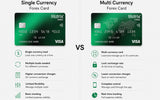
A Visa-based or Mastercard-based forex card works anywhere the corresponding network is accepted, which in Japan means almost everywhere in Tokyo, Osaka, Kyoto and Fukuoka. It will also withdraw yen at the four ATM networks above. Load it with yen before you fly and you fix the rate once rather than converting on every transaction.
Two Japan-specific cautions. RuPay has effectively no acceptance in Japan, so it should not be your main card. And if your forex card is Visa-based, the Seven Bank fee above applies where a Mastercard's would not.
UPI does not work in Japan as a general payment method. Our guide to using UPI abroad sets out where it does and does not, and Japan is firmly in the second category.
What does work brilliantly is a Suica or Pasmo IC card, the rechargeable transit cards. They cover trains, buses, most convenience stores and a surprising number of vending machines and small shops. Loading one on arrival removes most of your need for loose cash.
Japan is not the cash-only country it used to be
The old advice was to carry a large cash float because Japan ran on notes. That has changed materially.
Contactless cards, Suica and QR wallets now work at most chains, train stations, convenience stores, hotels and a growing share of small restaurants in the big cities. Where cash still rules is narrower than the reputation suggests: small ramen shops and standing bars, traditional sento, some shrines and temples, rural ryokan, older vending machines, and small-town businesses generally.
None of those need much money. Carrying two days of incidentals in your wallet and leaving the rest in the hotel safe covers a normal trip, which is what our Japan travel guide recommends and why the withdrawal sizes in this article are modest.
One thing worth knowing if you are handed unfamiliar notes: Japan issued a redesigned series in 2024, so both old and new ¥1,000, ¥5,000 and ¥10,000 notes are in circulation and both are valid. Our guide to Japanese yen notes and their security features covers what to look for.
Always choose yen at the screen
Partway through the withdrawal, the machine may offer to charge you in Indian rupees instead of yen, with a rate on screen that looks reasonable.
Decline it.
This is dynamic currency conversion, and accepting it hands the exchange rate to the machine's operator rather than your card network. Visa's own guidance is explicit that a DCC transaction carries the operator's rate plus whatever fees it applies, and that you are entitled to see both before you decide.
- Choose JPY. Always the local currency, yen.
- Decline the conversion when asked to accept or decline.
- The same question appears at hotels, and at electronics stores like BicCamera and Yodobashi where the ticket sizes are large enough to matter. Same answer.
Common mistakes at ATMs in Japan
Trying a Mizuho, MUFG, SMBC or Resona machine. They are the most visible bank ATMs in Japan and they will not take your card. This is not a fault with your card.
Assuming a decline means a blocked card. Walk to the nearest 7-Eleven and try there before calling your bank from overseas.
Taking ¥5,000 at a time. Every withdrawal carries a flat fee from your Indian bank and, on a Visa card, from Seven Bank too.
Carrying a large cash float out of habit. Japan is far more card-friendly than its reputation. Unspent yen comes home with you.
Using the currency exchange kiosks in Shibuya, Shinjuku or Dotonbori. They run several percentage points off the market rate, and hotel front desks are usually worse. An ATM withdrawal beats both.
Relying on RuPay or UPI. Neither is a working payment method in Japan.
Accepting the rupee amount at the screen. It reads more clearly and it costs more.
Not keeping the receipt. If a machine debits you without dispensing, the receipt and the timestamp are what get your money back.

Frequently asked questions
Which ATMs in Japan accept Indian cards?
Four networks. Seven Bank machines inside every 7-Eleven, Japan Post Bank machines in post offices, Lawson Bank machines in Lawson stores, and E-net machines at FamilyMart and other locations. All run 24 hours except Japan Post, which varies by branch, and all offer an English interface. The branch ATMs of Mizuho, MUFG, SMBC and Resona do not accept foreign-issued cards, despite being the most visible bank machines in the country.
Why was my Indian card declined at a Japanese ATM?
Most likely you used a machine that does not serve foreign cards. The big Japanese retail banks, Mizuho, MUFG, SMBC and Resona, do not accept foreign-issued cards at their branch ATMs. Nothing is wrong with your card. Walk to the nearest 7-Eleven and use the Seven Bank machine, which accepts Visa and Mastercard and runs around the clock.
How much do Japanese ATMs charge foreign cards?
It depends on the network and, at Seven Bank, on your card. Seven Bank charges Mastercard, Maestro and Cirrus cards nothing, and charges Visa and Visa Electron ¥110 on withdrawals under ¥10,000 and ¥220 at ¥10,000 and above. Japan Post Bank charges nothing during business hours and ¥110 outside them. Your Indian bank's own markup and flat fee apply on top of whichever machine you use.
Does a forex card work in Japan?
Yes. A Visa-based or Mastercard-based forex card works anywhere the corresponding network is accepted, which covers almost everywhere in Tokyo, Osaka, Kyoto and Fukuoka, and it will withdraw yen at the four ATM networks that take foreign cards. Load it with yen before you fly to fix the rate once rather than converting on every transaction. RuPay has effectively no acceptance in Japan and should not be your main card.
How much does it cost to withdraw money in Japan with an Indian card?
In the worked example on this page, ¥30,000 at a mid-market rate of ₹0.6055 is worth ₹18,165, and the total debit comes to about ₹19,196 on a Visa card, roughly 5.7% above mid-market. On a Mastercard, where Seven Bank charges no fee, the same withdrawal costs about ₹19,063, or 4.9% over. The rest is your Indian bank: a markup of around 3.5%, a flat international ATM fee of ₹100 to ₹125, and 18% GST on both.
Can I use UPI in Japan?
No. UPI is not a working payment method in Japan, so do not plan around it. Use a Visa or Mastercard card, a forex card, or a Suica or Pasmo transit card, which covers trains, buses, most convenience stores and many vending machines and small shops.
Sorting your Japan money before you fly
Japan is the easiest destination in this series once you know the four names, and the most frustrating if you do not. The machines are reliable, the fees are modest, the English interfaces are good. The only real trap is walking up to the biggest bank in the country and being turned away.
Matrix Forex is an RBI Authorised Dealer Category-II, licence NDL-ADII-0023-2023, with branches in eight cities and doorstep delivery in sixteen. You can buy Japanese yen as cash or load a multi-currency forex card before you fly, and you see the rate and the applicable charges before you confirm the order. Given how card-friendly Japan now is, a modest cash float plus a card covers a normal trip comfortably.
Worth reading alongside this: our Japan travel guide for the trip-planning side, the JPY to INR page for the current rate, and RBI rules on carrying foreign currency abroad for the Indian departure limits.
If you are choosing what to carry rather than where to withdraw, forex card vs international debit card is the direct comparison, and what is a cross-currency fee matters if Japan is one stop on a longer trip. Our Dubai, Sri Lanka, South Korea and Prague ATM guides run the same arithmetic for those destinations, and the answers differ in each.
Same-day delivery · RBI-authorised · No hidden charges
Get Free Callback →More from the Blog