US Dollar
 Euro
Euro British Pound
 UAE Dirham
 Australian Dollar
 Singapore Dollar
Why Your Indian Card Will Not Work at Most Korean ATMs

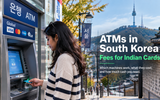
South Korea is the most card-friendly country in Asia and the hardest place on this list to get cash out of.
The problem is not fees. It is that the majority of cash machines in Korea are domestic-only: they serve Korean bank cards and will refuse an Indian debit card without explaining why. Travellers assume the card is blocked, or that their bank has flagged the transaction, and start making expensive phone calls from a convenience store at midnight.
The card is fine. The machine simply was not built for it. This guide covers how to spot the machines that will work, the opening hours that catch out anyone on a late flight, what a withdrawal actually costs, and how little cash you genuinely need in a country where almost everything takes a tap.

Look for the word Global
Korean ATMs fall into two groups, and the label is the whole trick.
Machines that accept foreign cards carry a Global sticker, or the Visa, Mastercard, Cirrus, Maestro or PLUS logos on the machine. Machines without those markings are for domestic cards and will decline yours, usually with an unhelpful error or by simply ejecting the card.
The reliable places to find a Global machine:
- Convenience stores. CU, GS25, 7-Eleven and Emart24 all host them, and in any Korean city you are rarely more than a few minutes from one.
- Bank branches. Woori, Shinhan, KEB Hana and the other major banks operate Global machines at most branches.
- Airports and major transport hubs. Incheon and the big stations are well covered.
If a machine refuses your card, do not assume the card is the problem. Walk to the next convenience store and try one with the Global marking. That single habit solves most of the "my card does not work in Korea" panic.
The opening hours nobody warns you about
This is the Korea-specific detail that catches Indian travellers hardest, because it does not exist at home.
Korean bank ATMs are not 24 hours. They typically run from around 07:00 to 23:30 and then shut. Separately, many machines across the country go offline between roughly 23:50 and 00:30 for daily system maintenance, which is exactly when a traveller on a late arrival is looking for cash.
Convenience store ATMs run 24 hours, which is the practical answer. They charge a little more, and the trade-off is worth it at midnight.
If you land late at Incheon, take what you need at the airport or plan on a convenience store. Do not assume you will find an open bank machine at 1am in Myeongdong, because you will not.
What it costs, and the limit that decides it
There are two sides to the bill, and in Korea the local side comes with a catch that matters more than its size.
| Convenience store Global ATM | Bank branch Global ATM | |
|---|---|---|
| Fee per withdrawal | About ₩3,000 to ₩3,600 | About ₩3,000 to ₩4,500, Woori reported lowest |
| Per-transaction limit | ₩300,000 | ₩1,000,000 |
| Hours | 24 hours | About 07:00 to 23:30 |
| How common | Everywhere | Bank branches only |
The limit is the part that decides the cost. The convenience store cap of ₩300,000 is roughly ₹21,000. If you need more than that, you are making two withdrawals and paying two lots of every flat fee, on both the Korean side and your Indian bank's side. A bank machine lets you take up to ₩1,000,000 in one go, but only while it is open.
So: bank ATM during the day for a large withdrawal, convenience store for anything at night or on top up.
What ₩300,000 actually costs you
The won sits around ₹0.0700 to the Indian rupee at the mid-market rate in early September 2026. That is the benchmark below, not a rate any retailer sells at, and it moves daily.
₩300,000 is the convenience store cap and a sensible single withdrawal, worth roughly ₹21,000.
| Line | Calculation | Amount |
|---|---|---|
| The won themselves, at mid-market | ₩300,000 × ₹0.0700 | ₹21,000 |
| Bank foreign currency markup | 3.5% of ₹21,000 | ₹735 |
| International ATM fee | flat, per withdrawal | ₹125 |
| GST | 18% of (₹735 + ₹125) | ₹155 |
| Korean ATM fee | ₩3,300 at ₹0.0700 | ₹231 |
| Total debited | ₹22,246 | |
| Cost above the mid-market rate | ₹1,246, or 5.93% |
The mid-market rate is indicative. The fee figures are assumptions drawn from published Indian bank schedules and reported Korean ATM charges, and both move.
Now the version that costs more for no reason. Say you need ₩600,000 for a week. Taken as two convenience store withdrawals, you pay the Korean fee twice and your Indian bank's flat fee twice, adding about ₹380 over doing it once at a bank machine. Not enormous, but it is pure waste, and it compounds if you are topping up ₩100,000 at a time.
Plan one larger withdrawal at a bank machine during the day rather than several small ones at night.

Always choose KRW at the screen
Partway through the withdrawal, many Korean machines offer to charge you in Indian rupees instead of won, with a rate on screen that looks reasonable.
Decline it.
This is dynamic currency conversion, and accepting it hands the exchange rate to the machine's operator rather than your card network. Visa's own guidance is explicit that a DCC transaction carries the operator's rate plus whatever fees it applies, and that you are entitled to see both before you decide.
- Choose KRW. Always the local currency, won.
- Decline the conversion when asked to accept or decline.
- The same question appears at card terminals in shops and restaurants. Same answer.
Accepting conversion also means your own bank's markup usually does not apply, because the transaction reaches it already in rupees. That is what makes the offer look like a saving when it is not: you are swapping your bank's markup for the operator's, and the operator's is larger.
How little cash you actually need
Korea is close to cashless, and this changes the whole calculation.
Contactless cards work at most established businesses. T-money, the rechargeable transit card, covers metro, buses, taxis and a great many convenience store purchases, and you can buy and top it up at any convenience store or station. Between a card and a T-money card, most visitors barely touch cash.
Where you still need won: traditional markets like Gwangjang and Namdaemun, street food stalls, small independent vendors, some temple entries, and the occasional older restaurant.
A practical float is ₩100,000 to ₩200,000 for a typical trip, topped up if you find yourself doing more market and street food eating than planned. That is roughly ₹7,000 to ₹14,000. Carrying much more than that in a country this cashless mostly means carrying it home again, and what to do with leftover foreign currency covers that end of it.
One more thing worth knowing before you rely on your phone: UPI is not a payment method in Korea. Our guide to using UPI abroad sets out where it does and does not work.
Common mistakes at ATMs in South Korea
Assuming a declined card is a blocked card. Most Korean machines simply do not take foreign cards. Find one marked Global before you call your bank.
Looking for a bank ATM after 11:30 PM. They are closed. Go to a convenience store.
Trying to withdraw between 11:50 PM and 12:30 AM. Many machines are down for daily maintenance in that window, regardless of type.
Topping up ₩100,000 at a time. Every withdrawal carries a flat Korean fee and a flat fee from your Indian bank. Fewer, larger withdrawals cost less.
Accepting the rupee amount because it is easier to read. It is easier to read. It is also the expensive option.
Carrying a big cash float out of habit. Korea does not need it, and unspent won comes home with you.
Relying on RuPay. Carry a Visa or Mastercard debit card, or a Visa-based forex card.
Not keeping the receipt. If a machine debits you without dispensing, the receipt and the timestamp are what get your money back.

Frequently asked questions
Why is my Indian debit card not working at Korean ATMs?
Most likely the machine is domestic-only. A large share of cash machines in South Korea serve Korean bank cards and will decline a foreign card without a clear explanation. Look for a machine marked Global, or displaying the Visa, Mastercard, Cirrus, Maestro or PLUS logos. Convenience store ATMs at CU, GS25, 7-Eleven and Emart24 are the easiest to find and generally accept foreign cards.
Which ATMs in South Korea accept foreign cards?
ATMs marked Global. In practice that means the machines inside CU, GS25, 7-Eleven and Emart24 convenience stores, machines at major bank branches including Woori, Shinhan and KEB Hana, and machines at airports and large transport hubs. Convenience store machines are the most widely available and run 24 hours, while bank machines are cheaper but keep limited hours.
Are Korean ATMs open 24 hours?
Convenience store ATMs are. Bank ATMs generally are not, typically running from around 07:00 to 23:30. Separately, many machines across Korea go offline between roughly 23:50 and 00:30 for daily system maintenance. If you land on a late flight, plan on a convenience store machine rather than a bank one.
What is the ATM withdrawal limit in South Korea?
Convenience store ATMs usually cap a single withdrawal at ₩300,000, which is about ₹21,000. Bank branch ATMs generally allow up to ₩1,000,000. If you need a larger amount it is cheaper to make one withdrawal at a bank machine during opening hours than two at a convenience store, because every withdrawal carries a flat fee on both the Korean side and your Indian bank's side.
How much does it cost to withdraw money in South Korea with an Indian card?
In the worked example on this page, ₩300,000 at a mid-market rate of ₹0.0700 is worth ₹21,000, and the total debit comes to about ₹22,246, roughly 5.9% above mid-market. That is made up of your Indian bank's markup of around 3.5%, its flat international ATM fee of ₹100 to ₹125, 18% GST on those charges, and a Korean ATM fee of about ₩3,000 to ₩3,600.
How much cash should I carry in South Korea?
Less than you probably think. Korea is close to cashless, contactless cards work at most established businesses, and a T-money transit card covers metro, buses, taxis and many convenience store purchases. A float of ₩100,000 to ₩200,000, roughly ₹7,000 to ₹14,000, suits most visitors. Keep cash for traditional markets, street food stalls and small independent vendors.
Sorting your Korea money before you fly
The Korean problem is availability rather than cost. The fees are ordinary; what is not ordinary is that most machines will not serve you and the cheap ones are closed when you need them.
Matrix Forex is an RBI Authorised Dealer Category-II, licence NDL-ADII-0023-2023, with branches in eight cities and doorstep delivery in sixteen. You can buy Korean won as cash or load a multi-currency forex card before you fly, and you see the rate and the applicable charges before you confirm the order. For a country this cashless, a modest cash float sorted in India plus a card covers almost everything.
Worth reading alongside this: our South Korea travel guide for the trip-planning side, the KRW to INR page for the current rate, and RBI rules on carrying foreign currency abroad for the Indian departure limits.
If you are deciding what to carry rather than where to withdraw, forex card vs international debit card is the direct comparison, and our Dubai, Sri Lanka and Prague ATM guides run the same arithmetic for those destinations.
Same-day delivery · RBI-authorised · No hidden charges
Get Free Callback →More from the Blog