US Dollar
 Euro
Euro British Pound
 UAE Dirham
 Australian Dollar
 Singapore Dollar
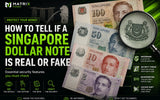
How to Spot a Fake Singapore Dollar Note Before It Costs You

A note by note guide to genuine Singapore dollar security features, checked against the Monetary Authority of Singapore and Singapore Police records, including the one mix up almost every SGD “spot the fake” graphic makes.
In September 2025, a 22 year old man walked into a bank in Clementi and tried to deposit a Singapore $10,000 note. He didn't get far. The counter staff took one look, suspected it wasn't genuine, and called it in. He's now facing charges under the Penal Code that carry up to 20 years in prison.
That's the pattern with counterfeit Singapore dollars. They rarely fool the person who's actually checking. They fool the person who isn't. MAS says genuine counterfeit cases in Singapore are low and mostly isolated, and when they do turn up, it's usually $10 polymer notes or $50 paper notes passed quickly at a shop counter where nobody's looking twice. Two men were charged in September 2025 over fake $50 notes used at restaurants in Geylang. That's the real shape of the problem: small, quiet, and easy to avoid once you know what you're holding.
If you're an Indian traveller heading to Singapore, a student, or a business dealing in SGD, this matters more than it might seem. Cash still gets used constantly in hawker centres, small shops and taxis, and if you're buying Singapore dollars before a trip or checking the live SGD rate for a transfer, it's worth knowing what a genuine note actually looks and feels like. Buying from an RBI-authorised dealer means the notes have already passed this kind of check once. Still doesn't hurt to know it yourself.
Here's the part most guides get wrong, and it's the reason we built this one from scratch instead of recycling a template. Singapore doesn't run one note design with a single checklist. It runs two, built on completely different materials with completely different security tech. A lot of the “real vs fake SGD” charts floating around (including, honestly, an early draft of our own reference images) apply the same features to every denomination regardless of which family it belongs to. That's not a small error. It means half the checklist doesn't exist on the note in your hand.
Singapore's Two Note Families: Polymer vs Paper
Since 1999, Singapore's currency has used the Portrait Series, named for the portrait of Yusof bin Ishak, the country's first president, that appears on every denomination. But the Monetary Authority of Singapore split the series into two physically different note types over time, and each one gets its own set of anti-counterfeiting features.
Polymer notes: $2, $5, $10. Printed on a specialised plastic film, not paper. These are the notes you'll handle daily, and they get clear windows, a shadow image instead of a classic watermark, and a gold foil patch instead of a hologram.
Paper notes: $50, $100, $1,000, $10,000. Cotton linen stock, the more traditional currency paper. These get a holographic Kinegram instead of a window, and a more conventional printed watermark you can hold up to the light.
The $1,000 and $10,000 notes are still legal tender, but MAS stopped issuing new ones years ago, the $1,000 from 1 January 2021 and the $10,000 all the way back on 1 October 2014, mainly to cut money laundering risk tied to large cash denominations. You'll rarely see either in daily use now, but if one turns up, the checks below still apply.
One thing that's identical across all seven notes regardless of material: every single one uses intaglio printing, the process that presses ink into the surface so it sits slightly raised. Run a finger over the portrait, the Coat of Arms, or the word “SINGAPORE” and you should genuinely feel texture. A colour photocopy or inkjet print stays completely flat, because it is.
Singapore $2 Note Security Features (Purple Polymer Note)
TWO CLEAR WINDOWS · GOLD LION PATCH, NOT A KINEGRAM · MONEY COWRIE, NOT AN ORCHID
The $2 is purple, measures 126mm by 63mm, and is one of the three polymer notes. Hold it up and you'll see two separate clear windows: one with a faint, multi-toned shadow image of Yusof bin Ishak that's visible from both sides, and a second, smaller one with the numeral “2” embossed at the centre and a repeating pattern of the same numeral around it.
Tilt the note and look near the top. Genuine $2, $5 and $10 notes show a stylised gold patch shaped like the Singapore Lion. Tilt it and the Singapore Coat of Arms appears inside the patch. This is worth remembering because a lot of generic currency infographics (including AI-generated ones, which is where a chunk of this confusion online actually comes from) slap a Kinegram on every denomination without checking. Polymer notes don't have one. The gold Lion patch replaces it entirely.
The background pattern behind the portrait carries the Money Cowrie, a small sea shell, not the orchid flower some illustrations mistakenly show. On the back, the note carries an “Education” theme, a classroom scene referencing Victoria Bridge School and the old Raffles Institution, both tied to Yusof bin Ishak's own schooling.

REFERENCE: Singapore $2 note, security-feature guide (front and back). Schematic diagram, not a photograph.
Singapore $5 Note Security Features (Green Polymer Note)
SAME POLYMER FEATURES AS THE $2 · GOLD-RINGED COWRIE · GARDEN CITY THEME
The $5 is green, 133mm by 66mm, and shares every core security feature with the $2: the two clear windows, the gold Lion tilt patch, the island-shaped security thread you'll read about below, and the same intaglio printing on the portrait.
What's unique to this note is the back design. It shows the old tembusu tree at the Singapore Botanic Gardens, over two hundred years old, paired with Vanda Miss Joaquim, the country's national flower. There's a nice bit of trivia here MAS mentions on its own site: Yusof bin Ishak actually worked as an orchid grower for a period before his political career, so the flower isn't just decoration. The front background carries the Gold-Ringed Cowrie shell.

REFERENCE: Singapore $5 note, security-feature guide (front and back). Schematic diagram, not a photograph.
Singapore $10 Note Security Features (Red Polymer Note)
MOST HANDLED SGD NOTE · SAME POLYMER SECURITY SUITE · WANDERING COWRIE
Red, 141mm by 69mm, and probably the note you'll touch most often alongside the $2. Same polymer features apply here: two clear windows, gold Lion patch instead of a Kinegram, and the Singapore-island-shaped security thread embedded in the plastic rather than a printed line.
The $10 was actually the first Singapore note issued in polymer form back in 2004, ahead of the $2 and $5 versions that followed a few years later. Its front carries the Wandering Cowrie, and the back shows a sports theme, a jogger, tennis and football on one side, swimming and sailing on the other, a nod to Yusof bin Ishak's own background as a national boxing and weightlifting champion in his youth.

REFERENCE: Singapore $10 note, security-feature guide (front and back). Schematic diagram, not a photograph.
Singapore $50 Note Security Features (Blue Paper Note)
FIRST OF THE PAPER NOTES · REAL KINEGRAM HERE · NO CLEAR WINDOW
This is where the note construction flips entirely. The $50 is blue, 156mm by 74mm, and printed on cotton linen paper, not polymer. That single fact changes almost the whole checklist.
Instead of a clear window, look for the Kinegram, an octagonal holographic foil near the top of the note. Tilt it and the denomination numeral inside should visibly shift, while the MAS logo changes into the Singapore Lion symbol. The background inside the foil has a faint shimmer that swings between bright and dark as you rotate the note, made up of shapes meant to resemble electron orbitals.
You'll also find a proper watermark here, not the “shadow image” language used for polymer notes. Hold the $50 to the light and a portrait watermark of Yusof bin Ishak appears, along with a separate, fainter watermark of the numeral just below it. The security thread is a straight, woven line through the paper carrying tiny repeated text reading the denomination and “SINGAPORE,” visible as a solid dark line when held up. The Cylindrical Cowrie sits in the front background, and the back carries an Arts theme built around four instruments, the Chinese pipa, Malay kompang, Indian veena and a classical violin.
Worth flagging since Singapore Police specifically named $50 notes in a recent counterfeit case: this is one of the two denominations most likely to actually get faked in practice, alongside the $10. Worth a proper look before you accept one, especially from a stranger.

REFERENCE: Singapore $50 note, security-feature guide (front and back). Schematic diagram, not a photograph.
Singapore $100 Note Security Features (Orange Paper Note)
SAME PAPER SECURITY SUITE AS THE $50 · SWALLOW COWRIE · YOUTH THEME
Orange, 162mm by 77mm, and one of the more commonly exchanged notes for travel money precisely because it packs a lot of value into a small stack. It carries the same Kinegram, portrait watermark plus highlight watermark, and straight security thread you'd check on the $50.
The front shows the Swallow Cowrie in the background pattern. On the back, a “Youth” theme runs across the note, showing Red Cross, St John Ambulance and NPCC cadets, a group of Scouts on an outdoor activity, and a National Service officer standing before the SAFTI Military Institute tower.
If you're picking up cash before a Singapore trip, this is usually one of the denominations you'll actually be handed at a counter, so it's worth knowing the Kinegram tilt check cold. Zero markup currency exchange through a licensed dealer means you're getting notes that have already cleared this kind of check, but a thirty second glance never hurts.

REFERENCE: Singapore $100 note, security-feature guide (front and back). Schematic diagram, not a photograph.
Singapore $1,000 Note Security Features (Purple Paper Note, No Longer Issued)
NOT ISSUED SINCE 1 JANUARY 2021 · STILL LEGAL TENDER · NATIONAL ANTHEM MICROPRINTED ON THE BACK
You're unlikely to run into a $1,000 note day to day. MAS stopped issuing new ones from 1 January 2021 as a step against money laundering risk tied to large denominations, but every $1,000 note already in circulation remains fully legal tender. If one does turn up, don't assume it's automatically suspicious just because it's rare, but do check it carefully.
It's purple, 170mm by 83mm, and carries the same paper note features as the $50 and $100: Kinegram, portrait and highlight watermark, straight security thread, Beautiful Cowrie shell in the background. The one feature genuinely unique to this note is on the back: the complete lyrics of Majulah Singapura, the national anthem, printed in microtext so small you need real magnification to read it. If that text is missing, blurred, or simply not there, treat the note as suspect. The back design itself shows the Istana at centre, flanked by Parliament House and the Supreme Court, representing the Executive, Legislature and Judiciary.

REFERENCE: Singapore $1,000 note, security-feature guide (front and back). Schematic diagram, not a photograph.
Singapore $10,000 Note Security Features (Gold Paper Note, No Longer Issued)

REFERENCE: Singapore $10,000 note, security-feature guide (front and back). Schematic diagram, not a photograph.
NOT ISSUED SINCE 1 OCTOBER 2014 · STILL LEGAL TENDER · THE NOTE FROM THAT CLEMENTI BANK CASE
This is Singapore's largest denomination, gold coloured, 180mm by 90mm, and it's exactly the note from the Clementi case mentioned at the start of this guide. MAS pulled it from new issuance back in October 2014, again over money laundering concerns, though existing notes stay legal tender.
Because so few are in circulation and MAS doesn't publish detailed public commentary on this one specifically, the safest approach is to apply the same paper note checklist used for the $50, $100 and $1,000: Kinegram tilt check, portrait watermark, straight security thread, intaglio texture on the portrait and Coat of Arms. The front carries the Onyx Cowrie, and the back depicts an Economics theme, a research scientist working with lab equipment, a microprocessor and silicon wafer, and protein sequences referencing research from the Institute of Molecular and Cell Biology.
Given its size and rarity, if a $10,000 note ever comes your way, it's worth having MAS verify it directly rather than relying on a quick glance alone.
How to Actually Check a Note: MAS's Look, Tilt, Feel Method
MAS boils all of this down to a three step routine they call Look, Tilt, Feel, and honestly, it's the whole guide compressed into fifteen seconds once you've done it a couple of times.
Look. Hold the note up to light. On paper notes, check for the portrait watermark and the highlight watermark of the numeral. On polymer notes, check for the shadow image inside the clear window instead, and confirm the microtext reading “MONETARY AUTHORITY OF SINGAPORE” sits cleanly above the four language “SINGAPORE” line.
Tilt. This is the step people skip most. On paper notes, the Kinegram numeral should visibly shift and the logo should change from the MAS mark to the Singapore Lion. On polymer notes, the gold patch should reveal the Coat of Arms. Either way, something should visibly move. If nothing changes no matter how you angle it, that's your biggest red flag.
Feel. Run a finger over the portrait, the lettering, and the Coat of Arms. Genuine intaglio printing sits slightly raised. It should feel like texture, not a flat surface. This single check catches a surprising number of low effort counterfeits on its own, since photocopiers and inkjet printers simply can't replicate raised ink.
If You Think You're Holding a Counterfeit Singapore Dollar Note
Don't spend it, and don't try to hand it back to whoever gave it to you and call it settled. Once a counterfeit note is accepted, that's a straight loss. No bank or shop will reimburse you for it, and circulating counterfeit currency is itself a criminal offence in Singapore, even if you didn't know the note was fake to begin with.
Keep the note exactly as you found it. Don't cut it, fold it strangely, or write on it. If you can, note down details about who gave it to you: a physical description, what they were wearing, any vehicle involved. Then limit how much you handle it, ideally slide it into an envelope or a folded piece of paper, and report it to the nearest Neighbourhood Police Centre as soon as possible, or call the Commercial Affairs Department directly.
Under Singapore's Penal Code, forging or counterfeiting currency carries a prison term of up to 20 years plus a fine. Knowingly using a counterfeit note carries the same maximum. Even just possessing one, if you knew or had reason to believe it was fake, can mean up to 15 years. That's not a scare tactic, it's exactly what a 23 year old man received a five year sentence for after using fake $50 notes at a convenience store, a case that made the news precisely because the notes were bad enough to get caught the second time around.
If you're genuinely unsure and the note hasn't actually been rejected anywhere, MAS will verify a note's authenticity for you directly through their feedback form. That's a far better outcome than assuming, spending it, and finding out the hard way.
Frequently Asked Questions
Do all Singapore dollar notes have the same security features?
No, and this is the single biggest misconception floating around online. Singapore runs two note systems. The $2, $5 and $10 are polymer notes with clear windows and a gold Lion tilt patch. The $50, $100, $1,000 and $10,000 are paper notes with a Kinegram hologram and a traditional watermark instead. Applying one checklist to every denomination will have you checking for features that don't exist on the note in your hand.
Is the $1,000 Singapore note still legal to use?
Yes. MAS stopped issuing new $1,000 notes from 1 January 2021 to reduce money laundering risk tied to large denominations, but every note already in circulation remains fully legal tender and can still be used for payment.
What's the fastest way to check if a Singapore dollar note is real?
MAS recommends Look, Tilt, Feel. Look for the watermark or shadow image against light. Tilt the note and confirm the Kinegram or gold patch actually changes. Feel the portrait and lettering for raised, textured ink. If all three check out, the note is almost certainly genuine.
Do Singapore $2, $5 and $10 notes have a Kinegram?
No. That's a common mix up in generic currency guides. Polymer notes ($2, $5, $10) replace the Kinegram entirely with a gold foil patch shaped like the Singapore Lion, which reveals the Coat of Arms when tilted. Only the paper notes ($50, $100, $1,000, $10,000) carry an actual Kinegram.
Which Singapore dollar denominations are most commonly counterfeited?
Based on recent Singapore Police cases, $10 polymer notes and $50 paper notes come up most often, usually passed quickly at small shops, restaurants and hawker stalls where transactions move fast and nobody looks closely.
What happens if I accidentally accept a fake Singapore dollar note?
You lose the value of that note. Banks and shops won't reimburse counterfeit currency. You should avoid spending it further, since knowingly passing on a counterfeit note is itself a criminal offence under Singapore's Penal Code, and instead report it to the nearest Neighbourhood Police Centre with as much detail as you can recall about where it came from.
Where can I buy genuine Singapore dollars before travelling from India?
Through an RBI-authorised dealer offering live interbank rates, rather than an unlicensed counter or street exchanger. Licensed dealers are required to run their own currency checks before notes ever reach a customer, which adds a layer of protection you don't get buying cash informally.
The Short Version
Spotting a fake Singapore dollar note was never really about memorising ten features and hoping half of them apply. It's about knowing that Singapore actually runs two different note systems, and checking the three things, look, tilt, feel, that matter for whichever one is in your hand. A $2 note and a $1,000 note share a currency and a portrait. They don't share a construction.
Keep a genuine note of each type nearby if you can, even straight from your own wallet after a trip, and compare anything that looks slightly off against it directly. And if a note ever genuinely gives you pause, there's no harm in just declining it and asking for another. That's what MAS itself recommends too.
Ready to Exchange? Get Zero Markup Rates
Same-day doorstep delivery · RBI-authorised Category-II dealer · No hidden charges
Get Free Callback → Check Live SGD Rate →
Related reading
How to Tell If a $100 Bill Is Real · How to Spot a Fake Pound Note · How to Spot a Fake Euro Note · ATMs in Singapore: Complete Guide · INR to SGD Live Rate
Same-day delivery · RBI-authorised · No hidden charges
Get Free Callback →More from the Blog