US Dollar
 Euro
Euro British Pound
 UAE Dirham
 Australian Dollar
 Singapore Dollar
Best Multi-Currency Forex Card in India 2026

Introduction
Let us say you are about to pick a multi-currency forex card for your travels, and you search for the best one. What you will find is a pile of articles, each crowning a different card as number one, and most of them are really just lists of whoever is paying for the placement. That does not help you much. So instead of handing you another top-five list, let us do something more useful: give you a simple way to judge any card for yourself.
A multi-currency forex card holds several currencies on one card and lets you spend in each country from the matching currency, with no extra conversion. The category itself has matured, and most providers now offer something similar. The real differences are in the details, and the details are where your money is quietly made or lost. So in this guide we will go through the five things that actually separate a genuinely good card from a well-marketed one, so the card you choose saves you real money rather than marketed money.
What a multi-currency forex card actually is
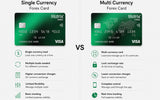
Let us start with the basics. A multi-currency forex card is a prepaid card that holds more than one foreign currency at the same time. You load rupees from your Indian bank account, the provider converts that into the currencies you choose, and each currency sits in its own wallet on the card. Then, when you spend in a country, the card automatically takes the money from the matching wallet, so a dollar spend comes from the dollar wallet and a euro spend from the euro wallet.
The benefit over an old single-currency card is that you avoid the extra conversion charge each time you spend in a currency you have loaded. The benefit over a credit card is that there is no foreign-currency markup on every swipe, and your home bank account is never exposed to fraud abroad. There is one catch worth remembering, though: if you spend in a currency you have not loaded, the card converts on the spot and adds a cross-currency charge. So a multi-currency card works brilliantly when you load the right currencies for your trip, and loses its advantage if you load the wrong ones.
The five things that actually separate the best from the rest
Here is the framework. Score any card you come across on these five points, and the strongest one will stand out regardless of how loudly it is advertised.
One: the rate at the time of loading
This is the single most important thing, and it is the one most cards quietly get wrong. Many cards advertise zero markup, but that’s not mostly the reality. A genuinely zero-markup card converts your rupees to the foreign currency at the live market rate you can see on Google or a rate site at the moment you load. A card that only claims zero markup may convert at a slightly worse rate while charging no separate fee, so the markup is mostly hidden inside the rate itself.
The way to test it is easy. At the moment you load, check the live rate on Google and compare it with the rate the provider is offering. If the provider's rate is very close to the live rate, the zero-markup claim is real. If it is noticeably worse, there is a hidden markup buried in the rate, even though nothing shows up as a fee on the invoice. On a large load, even a small gap in the rate quietly becomes a meaningful amount of money. RBI Category-II authorised dealers are inspected on their rate practice and tend to offer genuinely live rates, while some app-only providers route through a partner whose rate is harder to check.
Two: the currencies it supports
The best multi-currency cards support a good spread of currencies, comfortably covering the common ones, US dollars, euros, pounds, Australian and Canadian dollars, Singapore dollars, yen, dirhams, Swiss francs, and a few more. For most Indian travellers, around eight to ten currencies cover every realistic destination. Beyond that, extra currencies only matter if your travel takes you somewhere specific, a Thailand trip needs the baht loaded, a Switzerland trip needs francs. So the practical advice is simple: before you load, check that your actual destination currencies are on the card rather than assuming they are.
Three: how fast it is issued, reloaded, and replaced
Speed matters in three moments, so let us take them in turn. Issuance speed matters for a last-minute trip; the best providers can issue and deliver a card the same day in major cities, sometimes including weekends, while the usual timeline is a few working days. Reload speed matters mid-trip. With Matrix Forex, a family member can arrange a top-up through the branch that reflects within about an hour. And replacement speed matters most when something goes wrong; if your card is lost abroad, the best providers can courier a replacement to your hotel within a day or two and move your balance across, while slower ones can leave you stranded for a week or more. Some cards even include a linked backup card that activates the moment the main one is blocked.
Four: how honest the fee schedule is
Fees are where many cards quietly take a little extra, so it is worth knowing what to look at. Check the issuance fee, which is often small or waived these days. Check the reload fee, which should be nil or a small flat amount, because a reload fee charged as a percentage of the amount is really a hidden markup in disguise. Check the ATM withdrawal fee abroad, remembering the foreign ATM may add its own charge on top. Watch out for an inactivity fee, which some cards apply each month after the card has been unused for a while, quietly draining a card you forgot about. And look closely at the balance refund fee, the charge to convert your leftover money back to rupees; a flat fee is fine, but a refund priced as the rate minus a percentage is another hidden conversion cost. A transparent card states each of these as a clear number, while an opaque one hides behind vague phrases.
Five: who actually issues the card
This last one is less obvious but matters more than most people realise. Forex cards are issued in two ways. In the first, an RBI Category-II authorised dealer holds the licence itself and runs the whole card programme end to end. In the second, an app-based company that does not hold its own licence runs the customer side, while a partner bank or dealer holds the actual licence and the regulatory responsibility behind the scenes.
Both are perfectly legal. The difference shows up if something goes wrong. With a direct authorised dealer, your KYC, your money, and your dispute all sit with the licensed entity, which usually means tighter rate practice and quicker dispute resolution. With the app-on-partner model, the company you deal with is not the one holding the licence, which can add friction when you need a problem fixed. The simple check is to ask the provider which entity actually holds the licence for the card, and then verify that entity on rbi.org.in.
Why the most-advertised card is rarely the best
Here is something worth sitting with. The most heavily advertised cards are usually not the best ones on the five points above, and the reason is straightforward. A big marketing budget tends to go hand in hand with a healthy margin, and that margin has to come from somewhere, usually a slightly worse rate hidden in the load. A card that genuinely loads at the live rate with no markup simply earns less per transaction than one that claims zero markup while quietly carrying a small spread.
The same goes for the slick app-based cards with polished design and a strong social media presence. The experience is lovely, but the underlying rate is sometimes a touch worse than what an established authorised dealer offers directly. The gap only shows itself if you check the rate against the live market at the moment of loading, and most people never do, which is exactly why these cards can keep their pricing the way it is.
What changes for different kinds of travellers
The right card also depends a little on the kind of traveller you are, so let us cover the common cases. If you travel abroad only once a year, the inactivity fee and the refund fee matter most to you, since the card spends long stretches unused between trips; choose one that clearly does not charge for inactivity. If you are a frequent business traveller, speed of replacement and reload matters more than small fee differences, because a card that reaches your hotel within a day the one time you lose it pays for itself instantly. And if you are a multi-country traveller or a digital nomad, the range of currencies matters most, so check that every destination currency is loadable, and consider carrying a second card from a different provider as a backup on long trips.
Putting It All Together
The best multi-currency forex card in 2026 is not about the brand name. It is the one that loads at the live market rate with no hidden markup, supports all the currencies you actually need, is issued and replaced quickly, lists its fees honestly with no inactivity or hidden refund charges, and is issued directly by an RBI Category-II authorised dealer rather than through an app-on-partner arrangement. Marketing spend is a poor guide to any of these. So verify the provider on rbi.org.in, check the load rate against the live rate before you commit, and the rest is just execution. A small difference in the load rate, repeated across years of travel, quietly adds up to enough to fund a trip or two, which is exactly why this one check is worth the minute it takes.
Frequently asked questions
What is the best multi-currency forex card in India for 2026?
The best card is the one that loads at the live market rate with no hidden markup, supports your destination currencies, offers fast issuance and replacement, and is issued directly by an RBI Category-II authorised dealer. Brand recognition matters far less than these. Verify any provider on rbi.org.in and check the load rate against the live rate before committing.
How do I compare forex cards from different providers?
Score each on five points: the rate at loading, the speed of issuance, reload, and replacement, how honest the fee schedule is, the currencies supported for your destinations, and whether the issuer is a direct authorised dealer or an app working on a partner's licence. The card that scores best across these is your best choice, whatever its marketing presence.
How many currencies should a multi-currency card support?
For most Indian travellers, around eight to ten currencies cover every realistic destination. Cards supporting more offer only marginal benefit unless your travel includes specific places, so always check your particular destination currencies are supported before loading.
What does zero markup actually mean?
Genuine zero markup means your rupees convert to the foreign currency at the live market rate with no extra spread or fee. A misleading claim converts at a slightly worse rate while charging no separate fee, hiding the markup in the rate itself. Test it by checking the live rate at the moment of loading.
What hidden fees should I watch for?
Inactivity fees after a period of no use, balance refund charges priced as a percentage rather than a flat amount, percentage-based reload fees, and cross-currency charges when you spend in a currency you have not loaded. A clear fee schedule lists each as a flat number.
Is a forex card from a bank better than from a non-bank provider?
Not necessarily. Banks offer broader services but often less competitive forex rates, since forex is a side business for them. Non-bank RBI Category-II authorised dealers focus on forex and tend to offer rates closer to the live market with better forex-specific service. What matters is the authorisation and the rate practice, not whether the issuer is a bank.
How fast can I get a forex card issued in India?
The best providers offer same-day issuance and delivery in major cities, sometimes including weekends, if you apply early in the day. The usual timeline is a few working days. You will typically need your PAN, passport, a valid visa or exemption, and a confirmed travel ticket.
Same-day delivery · RBI-authorised · No hidden charges
Get Free Callback →More from the Blog