US Dollar
 Euro
Euro British Pound
 UAE Dirham
 Australian Dollar
 Singapore Dollar
Forex Card vs Credit Card Abroad: Which One Actually Costs You Less

A credit card is the easiest thing to reach for when you travel. It is already in your wallet, it works almost everywhere, and you do not have to plan anything in advance. That convenience is real. It is also where the cost hides.
Here is the short version. For everyday spending abroad, a forex card is usually cheaper than a credit card, because a forex card lets you lock in the exchange rate when you load it and skips the markup a credit card adds to every foreign swipe. A credit card earns its place for hotel deposits, emergencies and unplanned spends, where its flexibility is worth paying for. The sensible setup for most trips is to carry both and use each for what it does best. The rest of this guide shows where each one wins and what the difference costs in rupees.
How each card works abroad
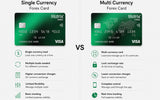
A forex card is a prepaid card you load with foreign currency before you travel. The exchange rate is fixed on the day you load it. After that, every swipe and ATM withdrawal draws down that balance at the rate you already locked, with no fresh conversion each time you spend.
A credit card works the other way around. It carries a rupee credit line, and every foreign transaction is converted to rupees on the day it is processed, at the card network's rate, with a markup added on top. You borrow against your limit and settle the bill later. Nothing is locked, and you are exposed to wherever the rupee sits on the day of each transaction.
That single difference, a rate locked in advance versus a rate applied at the moment of each swipe, is where most of the cost gap between the two comes from.
The markup that does not show on your statement
Every time you use a credit card abroad, the bank adds a foreign currency markup to the converted amount. This is typically between 1.8% and 3.5%, depending on the card. It does not appear as a separate line on your statement. It is built into the rupee figure you see against each transaction, which is exactly why most travellers never notice it.
On a trip where you spend ₹2 lakh on the card, a 3.5% markup is ₹7,000, quietly added across your transactions. Some premium travel cards advertise zero forex markup, and those are a genuine exception worth using if you hold one, but they usually carry an annual fee and the no-markup benefit can be limited to certain currencies.
A forex card loaded at the interbank rate skips this markup entirely. The rate you lock at load is the rate you spend at. With Matrix Forex, that load happens at the live interbank rate with no markup added, so there is no equivalent percentage quietly working against you while you travel.
Where the credit card gets expensive: cash withdrawals
The single most expensive thing you can do with a credit card abroad is withdraw cash from an ATM.
A cash withdrawal on a credit card is treated as a cash advance, which is a short-term loan against your card. Two charges land at once. There is a cash advance fee, usually 2.5% to 3% of the amount. And unlike a normal purchase, there is no interest-free period: interest starts accruing from the day of the withdrawal, at credit card rates that commonly run 30% to 45% a year.
Put real numbers on it. Withdraw the equivalent of ₹20,000 in cash on a credit card abroad, and the advance fee alone is ₹500 to ₹600. Carry that balance for a month at around 36% a year and the interest adds roughly another ₹600. That is ₹1,100 to ₹1,200 gone before you have spent the cash on anything.
A forex card charges a flat, modest fee per international ATM withdrawal and nothing resembling cash-advance interest, because you are withdrawing your own pre-loaded money, not borrowing. For anyone who needs cash on the trip, this is the difference that matters most.
The tax difference most travellers get wrong
There is a real tax distinction between the two, and it surprises people.
When you load a forex card, the amount counts towards your annual Liberalised Remittance Scheme usage, and TCS applies once your total LRS spending crosses ₹10 lakh in a financial year. For most leisure travel that TCS is 20% on the amount above ₹10 lakh, while education and medical purposes are charged at 2% above the same threshold. Education funded by a qualifying loan is charged nothing.
Spending on an international credit card while you are abroad is treated differently. It is not currently classified under the LRS, which means no TCS is collected on it. The government announced a plan to bring overseas credit card spending under the LRS, but the implementation has been deferred, so as things stand, credit card spending abroad sits outside the TCS net.
One thing keeps this in proportion. The ₹10 lakh threshold is a yearly total, and most leisure travellers never come close to it, so for them the TCS difference simply does not arise and the markup is the whole story. It matters only if your LRS spending for the year is already large.
And even where it does apply, TCS is not a cost you lose. It is an advance tax, fully adjustable against your income tax when you file your return. The markup and cash-advance charges on a credit card, by contrast, are real money you never get back.
Where the credit card genuinely wins
A forex card is not the better tool for everything. There are situations where a credit card is the right choice, and pretending otherwise would not be honest.
Hotels and car rental firms abroad usually place a hold, a temporary block, on a card at check-in to cover incidentals. A credit card is built for this, because the hold sits against your credit line rather than freezing your own money. Put the same hold on a forex card or a debit card and it locks up cash you may need.
A credit card is also the better safety net for genuine emergencies and large unplanned costs, where its flexibility gives you room. And some premium cards carry travel insurance and purchase protection that a forex card does not.
The point is not that one card is good and the other bad. It is that they are built for different jobs.
The setup that costs the least
For most international trips, the cheapest and safest approach is to carry both cards and split the work between them.
Use the forex card for everything you can plan: daily spending, shopping, dining, transport, and ATM withdrawals for local cash. This is where the locked rate and the absence of markup do their work, and it covers the bulk of most travel budgets.
Keep the credit card for hotel and rental deposits, for emergencies, and for any large unplanned expense where its flexibility earns its keep. Avoid using it for cash withdrawals unless there is no alternative.
Run that way, you get the cost control of the forex card for the everyday spending that makes up most of your trip, and the flexibility of the credit card for the few situations that genuinely need it.
Frequently asked questions
Is a forex card cheaper than a credit card abroad
For everyday spending, usually yes. A forex card lets you lock in the exchange rate at load and adds no transaction markup, while a credit card adds a foreign currency markup of about 1.8% to 3.5% to every foreign purchase.
Is there TCS on credit card spending abroad
No. International credit card spending while overseas is not currently classified under the Liberalised Remittance Scheme, so no TCS is collected on it. Forex card loads, by contrast, count towards your LRS limit and attract TCS above ₹10 lakh in a financial year.
Why is withdrawing cash on a credit card abroad so expensive
A credit card cash withdrawal is treated as a cash advance. It carries a fee of around 2.5% to 3%, and interest starts accruing immediately at credit card rates of 30% to 45% a year, with no interest-free period. On ₹20,000 withdrawn, that can mean ₹1,100 to ₹1,200 in charges within a month. A forex card charges only a small flat ATM fee, because you are withdrawing your own loaded money.
Can I use a credit card for hotel deposits abroad
Yes, and a credit card is the better choice for this. Hotels and car rental firms place a temporary hold to cover incidentals, and on a credit card that hold sits against your credit line rather than locking up your own cash, as it would on a forex card or debit card.
Should I carry both a forex card and a credit card
For most trips, yes. The cheapest setup is to use the forex card for planned everyday spending and ATM cash, and keep the credit card for hotel deposits, emergencies and large unplanned costs.
A credit card and a forex card are not really rivals. They are tools for different parts of the same trip. If you are getting ready to travel, Matrix Forex loads its Visa forex card in 28 currencies at the live interbank rate, with no markup and the cost shown to you upfront. Visit matrixforex.in to get started.
Same-day delivery · RBI-authorised · No hidden charges
Get Free Callback →More from the Blog