US Dollar
 Euro
Euro British Pound
 UAE Dirham
 Australian Dollar
 Singapore Dollar
RBI Rules on Carrying Foreign Currency Abroad: Cash & Card Limits

Introduction
When we plan a trip abroad, most of us spend a lot of time thinking about the exchange rate. We want the best rate when we buy our forex, and that is fair enough. But there is another question that matters just as much and gets far less attention: how much foreign currency are you actually allowed to carry out of India? The RBI and Indian Customs have clear rules on this, and if you break them, even by accident, your cash can be held up at the airport.
So let us go through these rules in plain language. We will cover how much cash you can carry, how the forex card fits in, when you need to fill a customs form, and what to do with any foreign currency you bring back home. By the end, you will know exactly how to pack your travel money without any worry at the airport.
First things first: the LRS comes before everything
Before we even get to cash limits, there is one bigger rule sitting above all of this, and that is the Liberalised Remittance Scheme limit. Every Indian resident can buy up to USD 250,000 worth of foreign exchange in a financial year, and this includes everything put together, your cash, your forex card balance, your traveller's cheques, and any wire transfers.
So the very first question is not really how much cash you can carry. It is how much of your LRS limit you still have left for the year. Once you know that, you can then decide how to split that money between cash, a forex card, and other forms. Think of the LRS as the big bucket, and the cash limit as just one rule about how much of that bucket you can carry as physical notes.
How much foreign currency cash can you carry?
Within your LRS limit, the RBI puts a separate cap on how much you can carry as actual currency notes. You cannot simply carry USD 250,000 in cash in your bag. The cash limit is much smaller, and here is how it works.
For most destinations, you can carry up to USD 3,000, or the equivalent in another currency, in foreign currency notes per trip. That is the standard limit for ordinary travel. There are a couple of exceptions worth knowing. If you are travelling to Iraq or Libya, you may carry up to USD 5,000 in cash. And if you are travelling to Iran, Russia, or the other republics of the Commonwealth of Independent States, you are actually allowed to carry your entire foreign exchange entitlement in the form of cash, because card payments can be difficult in those places.
Whatever is left over, beyond the cash you carry, has to travel in a non-cash form. In practice that means a forex card, traveller's cheques, or money you receive at your destination through a wire transfer or an ATM withdrawal.
How much can you load on a forex card?
Here is a question that surprises people: is there a separate carrying limit on a forex card? The answer is no, and the reason is simple. A forex card is not bearer cash. If you lose it, whoever finds it cannot use it without your PIN, so the RBI does not see it as risky the way it sees loose currency notes.
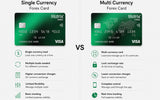
In theory, that means you could load your entire annual LRS limit onto a forex card. In practice, banks and dealers set their own limits for each card, and for most travellers a load somewhere between USD 3,000 and USD 20,000 covers a normal trip comfortably. A multi-currency forex card is honestly the smartest way to carry your travel money. You lock in the rate at the time you load it, you avoid those steep bank ATM fees abroad, and you stay well within the RBI rules without any airport hassle.
Are traveller's cheques still worth it?
You may be wondering about traveller's cheques, since they used to be the standard way to carry money abroad. They are still perfectly legal, but to be honest, they are fading away. Most shops, hotels, and restaurants abroad no longer accept them, and even banks charge high fees to cash them. There is no separate cap on traveller's cheques beyond your overall LRS limit, but in 2026, a forex card is simply a far more practical choice.
Carrying Indian rupees: a small limit but a firm rule
What about taking some Indian rupees along? You are allowed to carry up to 25,000 in Indian currency notes when you leave India, and you can bring back up to 25,000 in rupee notes when you return as well. Anything above 25,000 has to be declared to Customs.
In any case, Indian rupees are of little use outside India, since no shop abroad will accept them. So you really only need a small amount for the journey home, a taxi from the airport, a quick meal, a little buffer. Somewhere between 2,000 and 5,000 is usually plenty.
Bringing foreign currency back to India
Now suppose your trip is over and you have some foreign cash left over. What do the rules say you can do with it? You can bring back foreign currency notes freely, but the declaration rules kick in at certain points. If you are carrying more than USD 5,000 in cash, or if your total foreign currency including traveller's cheques crosses USD 10,000, then you must declare it on a Currency Declaration Form at customs.
As for keeping it, you are allowed to retain up to USD 2,000 worth of foreign currency notes or traveller's cheques for your own future use, say for your next trip. Anything beyond that USD 2,000 should be sold back to an RBI-approved dealer. The timelines to remember here are that unspent foreign currency notes should be surrendered within 90 days of your return, while traveller's cheques and forex card balances have a longer window of 180 days.

Declaring currency when you leave India
On the way out, most travellers do not need to declare anything at all, so let us be clear about when you actually do. You only need to declare foreign currency on departure if you are carrying cash above your limit, which is USD 3,000 or USD 5,000 depending on the destination, or if your total foreign currency including traveller's cheques goes above USD 10,000.
For the typical traveller carrying a forex card and a small amount of cash, there is nothing to declare. Remember, the forex card balance does not count towards the cash limit at all, so you can carry your card freely without a second thought.
When can you buy your travel forex?
Timing matters too. The RBI lets you buy your foreign exchange up to 60 days before your trip. So if you are flying out in June, you can start buying your forex any time from April onwards, which gives you the flexibility to wait for a good rate or buy it in parts.
There is a flip side, though. If you do not end up travelling within 60 days of buying your forex, you are expected to sell it back to an RBI-approved dealer. You cannot simply hold on to the cash indefinitely. The same applies if your trip gets cancelled, sell the unused forex back to the same dealer and you will recover most of your money.
The smart way to pack your travel money
So how do experienced Indian travellers actually carry their money? The usual mix looks something like this. They keep a small amount, perhaps USD 200 to USD 500, in foreign cash for tips, taxis, small purchases, and emergencies. The bulk of their spending sits on a multi-currency forex card, pre-loaded with the currency of their destination. They keep an Indian credit or debit card as a backup in case the main card is lost. And they carry a little Indian currency, under 5,000, for the journey home.
This combination keeps you neatly inside the RBI rules. You stay under the cash limit, you avoid any customs declarations, you have a backup if your main card goes missing, and you spend at the best rates because your forex card was locked in at the time of loading.
What happens if you break the rules?
It is worth being honest about the consequences, because they are not trivial. Carrying more cash than allowed without declaring it is treated seriously. Customs can seize the extra cash under FEMA and the Customs Act, the penalty can mean losing the excess amount along with additional fines, and in some cases it can even turn into a criminal investigation.
But here is the reassuring part. Declaration is your safety net. If you happen to be over the limit but you fill the Currency Declaration Form honestly, you are fine. The offence is the not declaring, not the amount itself. So when in doubt, always declare.
A couple of real airport situations
Let us make this concrete with two quick situations that play out at airports more often than you would think. In the first, a traveller flew to Dubai carrying USD 4,500 in cash, even though the cash limit for that route is USD 3,000, and chose not to declare it. Customs caught the excess, and the extra USD 1,500 was seized.
In the second, a family returned from Singapore with USD 8,000 in unused cash and walked through the green channel. Customs questioned them, and they ended up having to fill the Currency Declaration Form after the fact and surrender most of the cash to a dealer within the surrender window. The lesson from both is the same and very simple: know the limits before you fly, and when in doubt, use the red channel and declare. Declaring costs you nothing; not declaring can cost you a great deal.
Putting It All Together
The RBI rules on carrying foreign currency abroad are actually quite straightforward once you lay them out. Keep your cash under USD 3,000 for most destinations, put the rest on a multi-currency forex card, carry under 25,000 in Indian rupees out and back, and declare anything over USD 10,000 in total when you return. Sell any unused foreign currency notes back within 90 days, and cards or cheques within 180 days. Follow this little checklist and you will never have an awkward conversation with Customs. And if you load your forex card from an RBI-approved dealer, you also lock in a good rate, which quietly saves you real money on every spend abroad.
Frequently asked questions
How much foreign currency cash can I carry to the USA from India?
Up to USD 3,000 in foreign currency notes per trip. The rest of your travel money should go on a forex card or in another non-cash form.
Does my forex card balance count towards the USD 3,000 cash limit?
No. The cash limit applies only to physical foreign currency notes. Your forex card balance is separate and has no carrying limit.
Can I keep leftover foreign currency for my next trip?
Yes, but only up to USD 2,000 worth. Anything more than that should be sold back to an RBI-approved dealer, notes within 90 days of your return and cards or cheques within 180 days.
What if I forget to declare foreign currency above the limit?
Customs can seize the excess amount, and there may be a fine on top. So always declare anything above the limit on the Currency Declaration Form, it costs you nothing to do so.
Can children carry foreign currency on their own?
Each person, including children, has the same cash-carrying limit. Parents are responsible for any forex carried in a child's name.
Do I need to declare a forex card at the airport?
No. A forex card is not bearer cash, so it does not need to be declared. You can carry it freely.
How long before my trip can I buy forex?
Up to 60 days before. If you do not travel within those 60 days, you are expected to sell the unused forex back to a dealer.
Same-day delivery · RBI-authorised · No hidden charges
Get Free Callback →More from the Blog