US Dollar
 Euro
Euro British Pound
 UAE Dirham
 Australian Dollar
 Singapore Dollar
Forex Card vs International Debit Card: Which Is Cheaper for Travel?

Introduction
Let us say you are about to travel abroad and you are trying to decide how to pay for things once you land. Should you just carry your regular bank debit card, the one that already works, or should you get a separate forex card before you go? It is a fair question, and a lot of travellers default to the debit card simply because it is already in their wallet. But that easy choice often turns out to be the more expensive one.
So let us compare the two properly. We will look at what each card actually is, where the hidden costs sit, which one works out cheaper for a normal trip, and the few situations where a debit card is genuinely the better call. By the end you will know exactly which card to reach for, and why.
The short answer first
For most people travelling abroad, a forex card works out cheaper than an international debit card. The reason is simple: a forex card lets you lock in today's exchange rate when you load it, so you skip the markup and the extra cross-currency fee that a bank quietly adds to every debit card swipe abroad. The sensible setup for most trips is to use the forex card for your shopping, dining, and daily spends, and keep your debit card tucked away purely for emergencies.
What is a forex card?
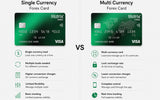
A forex card is a prepaid travel card. You load it with foreign currency before your trip, and the rate is fixed on the day you load it. After that you can swipe it at shops, pay online, or withdraw cash at an ATM abroad. A multi-currency forex card can even hold several currencies on the same card, so one card can carry US dollars, euros, pounds, dirhams, Singapore dollars and more, each in its own little wallet.
Because it is prepaid, the card does not need to check back with your home bank account every time you spend. That makes each swipe quick, and it keeps the cost flat and predictable, which is really the whole point of carrying one.
What is an international debit card?
An international debit card is simply your everyday debit card, switched on for use abroad. Every time you swipe it overseas, your bank pulls the money straight from your savings account in rupees and converts it into the local currency on the spot. The trouble is that the bank adds a markup on the exchange rate, often along with a service fee, and withdrawung cash at a foreign ATM usually costs more still. So the convenience of using a card you already have comes at a price you do not always see.
Where the costs really hide
This is the heart of the comparison, so let us go through it carefully. A debit card carries three costs abroad that are easy to miss. The first is the currency markup, where the bank adds a percentage on top of the live exchange rate every single time you swipe. The second is the cross-currency fee, which kicks in because your card's base currency is rupees, so spending in euros or dirhams means an extra conversion charge layered on. The third is a per-transaction fee that some banks apply on each overseas swipe or withdrawal.
A forex card sidesteps most of this. If you have loaded the right currency for your destination, there is no cross-currency fee at all, because you are spending the currency that is already on the card. The rate is the one you locked in at loading, so there is no fresh markup at each swipe. And many forex cards include a couple of free ATM withdrawals abroad each month. Add it up and the forex card is usually the cheaper way to spend, simply because it avoids the layers of conversion that a debit card runs through every time.
A simple way to picture the difference
Imagine two travellers on the same week-long Europe trip, each spending the same amount in euros. The first uses a debit card. Every purchase is converted from rupees to euros at the moment of the swipe, with the bank's markup added each time, plus a fee on the couple of ATM withdrawals. The second traveller loaded a forex card with euros before leaving, at the rate on that day. Her purchases come straight out of the euro balance with no fresh conversion and no markup at each swipe.
By the end of the trip, the forex card traveller has simply paid less for the same spending, because she paid the conversion cost once, up front, at a locked rate, rather than paying a markup again and again. On a single short trip the saving might be the price of a nice dinner; on a long student or work stay, where the spending is much higher, it adds up to a far larger amount. The exact figure depends on the rates and fees of the day, but the direction is always the same.
When a forex card is the better choice
A forex card makes the most sense in the situations most travellers are actually in. If you are going abroad for tourism, study, work, or a long visit, it fits. If most of your spending will be in shops, hotels, and restaurants, it fits. If you want to fix your travel budget in rupees before you leave, so there are no surprises from a moving exchange rate, it fits. And if you are visiting several countries, a single multi-currency forex card covers them all without juggling cash. For the typical trip, in other words, the forex card is the natural choice.
When a debit card is fine
That said, there are times a debit card is perfectly reasonable, so let us be honest about those too. If your trip is last-minute and you simply do not have time to load a forex card, the debit card will do. If you are only making a very small spend, like a short layover where you grab a coffee and little else, it is not worth setting up a forex card. And as a backup, a debit card is genuinely useful: if your forex card is lost or a particular merchant will not take it, having the debit card as a fallback is sensible. The key is to treat it as the backup rather than the main card.
Which card is safer abroad?
Safety is worth a moment, because the two cards differ in an important way. Both come with chip and PIN protection, but a forex card has one real advantage: if it is lost or stolen, only the amount loaded on it is at risk. With a debit card, your entire bank balance is exposed until you manage to block the card. On top of that, most forex cards let you lock and unlock the card from an app and come with a free backup card in the kit, so you are not stranded if the main one goes missing. For peace of mind abroad, the forex card has the edge.
Reloading while you are abroad
One more practical point in the forex card's favour. If you run low mid-trip, a modern forex card can be topped up from India, either by you or by a family member, through the branch, and the money usually shows up on the card within about an hour during working hours. A debit card, by contrast, depends entirely on your bank balance back home, so you may find yourself shuffling money around in rupees before each big spend. The forex card simply gives you more control while you are away.
A quick word on tax
There is a tax angle worth understanding, since it applies to forex card loads. Under the current rules, loading a forex card counts towards your yearly LRS use, and TCS applies once you cross 10 lakh in a financial year. For ordinary leisure travel, that TCS is 20 per cent on the amount above 10 lakh, while education and medical purposes are charged at a lower 2 per cent above the same threshold. The important thing to remember is that this TCS is not a cost you lose; you get full credit for it when you file your income tax return. Debit card spending abroad also falls under the LRS, though it is not taxed at the moment of each swipe in the same way. Since these rules do get revised, it is worth checking the current position before a very large load.
A simple rule for choosing
If you want one easy rule to decide, here it is. If your trip is more than a few days, or your spend is more than around 50,000, or you are travelling for school, college, or work, go with a forex card. For a short layover or a tiny spend, a debit card is fine, but keep it as the backup rather than your main way to pay. That single rule will steer you right almost every time.
Putting It All Together
For most travellers, a forex card is cheaper, safer, and easier to manage abroad than an international debit card. It lets you lock in your rate before you go, avoids the repeated markups and cross-currency fees a debit card adds at every swipe, protects your main bank balance if it is lost, and can be topped up from home when you need it. Carry a small amount of cash for tips and taxis, keep your debit card as a backup, and let the forex card do the day-to-day work. That combination gives you the best mix of cost, safety, and convenience on almost any trip.
Frequently asked questions
Is a forex card really cheaper than a debit card abroad?
In most cases, yes. The forex card locks your rate at loading and avoids the markup and cross-currency fee that a bank adds to each debit card swipe overseas, which is where most of the saving comes from.
Can I use a forex card to pay on foreign websites?
Yes. A forex card works for online payments in the currency you have loaded, so it can be used on international shopping, travel booking, and subscription sites just like a normal card.
What happens to the money left on my forex card after the trip?
You can keep it for your next trip, move it to a different currency on the card, or sell it back to rupees at the live rate. A small encashment fee may apply when you convert it back.
Are forex cards covered by RBI rules?
Yes. Forex cards are issued under RBI rules, and the amount you load counts towards your LRS limit of USD 250,000 per financial year.
Can I use a forex card at any ATM abroad?
It works at most ATMs that accept the card's network, such as Visa or Mastercard. The local ATM may add its own charge, but your card's side of the cost stays fixed.
What is the safest way to carry money abroad?
A forex card for most spending, plus a small amount of cash for tips and taxis, and your debit card kept aside as a backup. That mix keeps your main bank balance protected while giving you a fallback.
How long is a forex card valid?
Most forex cards are valid for several years from the date of issue, so you can reuse the same card across many trips rather than buying a new one each time.
Same-day delivery · RBI-authorised · No hidden charges
Get Free Callback →More from the Blog