US Dollar
 Euro
Euro British Pound
 UAE Dirham
 Australian Dollar
 Singapore Dollar
India's Forex Reserves: $766 Billion, and Almost None of It Is Cash

You are at a forex counter buying $2,000 for a trip to New York. The TV above the counter says India's forex reserves are close to a record. It feels natural to connect the two, as if the notes being counted out for you came from that giant national pile.
They didn't. Not one of those notes came from RBI's reserves, and almost none of India's reserves is held as cash in any form you would recognise.
India forex reserves stood at $765.9 billion (₹73.4 lakh crore) on 18 September 2026, according to the Reserve Bank of India. This guide explains what that money actually is, where it is kept, which currencies it sits in, how India builds it, and how the dollars in your wallet really reached the counter.

India Forex Reserves Today: The Latest Number
RBI reports the reserves every Friday. They come in four parts.
| Component | US$ billion | Share of total |
|---|---|---|
| Foreign currency assets | 630.98 | 82.4% |
| Gold | 111.29 | 14.5% |
| Special Drawing Rights (SDRs) | 18.74 | 2.4% |
| Reserve position in the IMF | 4.89 | 0.6% |
| Total forex reserves | 765.90 | 100% |
Source: RBI Weekly Statistical Supplement, 25 September 2026, position as on 18 September 2026. Shares calculated by Matrix Forex.
That figure is $63.3 billion higher than a year earlier. It is also $19.8 billion below the all-time high of $785.7 billion set on 4 September 2026, after a single-week jump of $44.9 billion. We come back to why that week was so unusual further down.
What Is a Forex Reserve?
A forex reserve is the stock of foreign assets a central bank holds so the country can keep paying its way in the world. India's belong to the RBI, which manages them under the RBI Act, 1934, and decides the broad strategy with the Government of India.
The four parts in the table mean:
- Foreign currency assets are bonds, treasury bills and deposits in major foreign currencies. This is the working money, and it is the part RBI uses to buy or sell dollars in the market.
- Gold is the physical metal RBI owns, valued at the market price.
- SDRs are an IMF reserve asset that member countries can exchange among themselves. You will never see one.
- The reserve position in the IMF is the part of India's IMF quota that India can draw on without conditions.
A reserve exists for bad days. It pays for imports if export earnings dry up, services foreign debt, and lets RBI slow a panicky fall in the rupee. India learnt the value of this the hard way. In mid-1991 its reserves covered only about three weeks of essential imports, and RBI had to pledge 67 tonnes of gold to raise emergency money.
How Much of India's Forex Reserves Is Actually Cash?
Almost none, if cash means banknotes. RBI's own reports list no category for foreign banknotes. Every rupee's worth of reserves is either a security, a bank deposit, gold, or a claim on the IMF.
RBI's half-yearly report on reserve management shows exactly how the foreign currency assets were deployed at end-March 2026.
| Where the money sits (end-March 2026) | US$ billion | Share of reserves |
|---|---|---|
| Foreign government and other high-grade securities | 465.61 | 67.4% |
| Deposits with other central banks and the BIS | 46.83 | 6.8% |
| Deposits with commercial banks overseas | 39.84 | 5.8% |
| Gold | 115.40 | 16.7% |
| SDRs | 18.62 | 2.7% |
| Reserve position in the IMF | 4.81 | 0.7% |
| Total | 691.11 | 100% |
Source: RBI, Half Yearly Report on Management of Foreign Exchange Reserves, October 2025 to March 2026 (Tables 1 and 4). Shares of total reserves calculated by Matrix Forex.
So the closest thing to "cash" is the $86.7 billion held as deposits, about an eighth of the total. Even that is digital: balances in accounts at other central banks, the Bank for International Settlements in Basel, and large foreign banks. The other seven-eighths is bonds, gold and IMF assets.
This is deliberate. RBI's stated priorities are safety and liquidity first, then return. Top-rated government bonds pay interest and can be sold in large amounts in a day, which a vault of paper dollars can do neither of.

Where RBI Keeps India's Gold Reserves
RBI held 880.52 tonnes of gold at end-March 2026. Of that, 680.05 tonnes sat in India, 197.67 tonnes were in safe custody with the Bank of England and the BIS, and 2.80 tonnes were in gold deposits.
That is a big shift. At end-March 2025, 512 of RBI's 880 tonnes, about 58%, were held at home; a year later it was 77%. RBI has been bringing gold back from London in stages, including a single move of about 100 tonnes in 2024.
Gold has also become a much larger slice of the reserves, from 13.9% at end-September 2025 to 16.7% at end-March 2026. Almost all of that rise came from the gold price. RBI's holding grew by less than one tonne over the whole year. When gold rises, India's reserves rise with it, even if RBI does nothing.
Which Currencies Are India's Reserves Held In?
Here is the honest answer: RBI does not publish the currency split. Any website that gives you "USD x billion, EUR y billion" for India is estimating.
What RBI does say is that the foreign currency assets are a multi-currency portfolio of major currencies such as the US dollar, euro, pound sterling and Japanese yen, reported in US dollars. It names the US dollar and the euro as its intervention currencies, the two it actually uses in the market.
The best public guide is the IMF's COFER survey, which pools the reserves of central banks worldwide.
| Currency | Share of world's allocated reserves, 2026 Q1 |
|---|---|
| US dollar | 57.1% |
| Euro | 20.0% |
| Japanese yen | 5.4% |
| Chinese renminbi | 2.0% |
| Pound sterling, Canadian and Australian dollars, Swiss franc and others | about 15% combined |
Source: IMF, Currency Composition of Official Foreign Exchange Reserves (COFER), 2026 Q1, released 1 July 2026. India's own split is not disclosed.
There is a practical reason the split matters even without the exact numbers. RBI counts everything in dollars. When the euro or yen falls against the dollar, India's reserves shrink on paper overnight, although RBI sold nothing.
How India Builds Its Forex Reserves
Reserves grow in three ways: RBI buys foreign currency, the assets earn interest, or their value rises. They shrink when RBI sells, when India repays certain official debt, or when valuations fall.
The dollars RBI buys come from India's dealings with the rest of the world:
- Remittances. Indians working abroad sent home $42.9 billion in April to June 2026 alone, up from $33.2 billion a year earlier.
- Services exports, mainly software and business services, earned a net $51.6 billion in the same quarter.
- Foreign investment. Direct investment brought in a net $6.1 billion that quarter. Portfolio investors took out $9.6 billion.
- Borrowing and deposits. Companies' overseas loans and NRI deposits add dollars too.
Against all that, India imports far more goods than it sells: a goods trade deficit of $86.1 billion in that one quarter, much of it oil. After everything, India ran a small current account deficit of $4.2 billion and its reserves fell by $8.1 billion on a balance-of-payments basis, per RBI's balance of payments release.
When more dollars arrive than importers and investors want, RBI buys the surplus to stop the rupee rising too fast, and reserves grow. When dollars are scarce, it sells, and they shrink.
Valuation can swamp all of this. Between April and December 2025, RBI's actual flows reduced reserves by $30.8 billion, yet the headline number still rose by $19.4 billion, because rising gold and currency values added $50.2 billion.
Why the reserves jumped $44.9 billion in one week
The September 2026 record was not a sign of a sudden trade windfall. In June, with the rupee under pressure, RBI opened a subsidised swap window for banks raising three-to-five-year FCNR(B) deposits from NRIs and made hedging cheaper for overseas borrowing. Banks swap the dollars they raise with RBI, and those dollars land in the reserves. Reports citing RBI data put the total drawn in by these schemes at about $136 billion by the end of August, most of it NRI deposits. We covered the deposit side in our guide to the FCNR(B) deposit window, which ran until 30 September.
There is a catch worth understanding. Swapped dollars are borrowed, not earned. RBI has to hand them back when the swaps mature in three to five years, which is why analysts read the headline alongside RBI's forward book. At end-March 2026, before these schemes, RBI's net forward position was a payable of $103.06 billion.
Where the Foreign Currency at a Forex Counter Actually Comes From
This is where most people's mental picture goes wrong. RBI does not hand foreign banknotes to banks or dealers from the reserves. The notes travel a completely separate route.
- Banks import them. Banks holding an Authorised Dealer Category-I licence import foreign currency notes from overseas banknote wholesalers, who ship them in insured consignments. The bank pays from its own foreign currency accounts abroad.
- Licensed dealers buy from banks and each other. Under RBI's Master Direction on Money Changing Activities, money changers and non-bank dealers may buy notes from banks and other licensed dealers. If they cannot get enough, they need RBI permission to import through a bank.
- Travellers bring notes back. Every returning traveller who sells leftover dollars, and every foreign tourist who changes money in India, adds notes to the local supply.
- Surplus goes back out. Notes that are not needed are exported to an overseas bank through an AD Category-I bank.
Since 1 July 2024, money changers and non-bank dealers must sell to the public at least 75% of the value of the notes they buy from other dealers, every quarter. The rule exists so that notes reach travellers instead of sitting in a dealer's stock.
So where do the reserves come in? Only indirectly. A bank paying a wholesaler needs dollars, and it buys them in the same interbank market where RBI buys and sells. The reserves influence the price of those dollars. They do not supply the notes.
This also explains why cash usually costs more than a forex card. Every note has to be shipped, insured, stored, counted and checked for fakes, and unsold notes tie up money. A card load is a digital transfer with none of that. Our forex card vs cash guide works through the numbers, and the RBI rules on carrying foreign currency set out how much cash you can take on a trip.

What the Reserves Mean for the Rate You Pay
The reserves do not set your exchange rate. RBI does not fix the rupee at a number. It uses the reserves to slow sharp moves, selling dollars when the rupee falls too fast and buying when it rises too fast.
You can see the result in RBI's own weekly figures. The rupee was about ₹94.5 to the dollar on 4 September and ₹95.9 on 18 September 2026. Our piece on why the rupee crossed ₹95 explains the oil shock and investor outflows behind that slide, and why the exchange rate changes every day covers the daily mechanics.
The rate you pay at a counter is the interbank rate plus the dealer's margin. Large reserves help keep the interbank rate from lurching, which makes a quote you book today more likely to be close to tomorrow's. They do not make the rupee strong, and a record reserve number does not mean cheaper dollars next week.
Is India's Forex Reserve Big Enough?
By the usual tests, yes, comfortably:
| Test | India | What it tells you |
|---|---|---|
| Import cover | 10.8 months (end-December 2025) | How long reserves could pay for imports with no other income. Three months is the traditional minimum. |
| Short-term external debt to reserves | 21.9% (end-December 2025) | Reserves could repay all short-term external debt about four and a half times over. |
| Volatile capital to reserves | 69.1% (end-December 2025) | Even if all short-term debt and past portfolio inflows left, reserves would cover it. |
Source: RBI, Half Yearly Report on Management of Foreign Exchange Reserves, October 2025 to March 2026, section I.5.
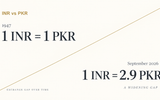
After the September jump, reports put India's reserves fourth in the world, behind China, Japan and Switzerland. For comparison, the $1.2 billion India had at the start of 1991 would not cover a single day of imports today. If you want to see how the rupee has travelled since independence, our story of 1 USD to INR in 1947 covers it, and the INR vs PKR post shows what thin reserves look like next door.
Five Common Misreadings of India's Forex Reserves
"Record reserves mean the rupee will strengthen." No. Reserves hit a record in September 2026 while the rupee kept weakening. Reserves slow a fall; they do not reverse one.
"The dollars I buy come from RBI." They come from imported notes and travellers' leftovers, sold through banks and licensed dealers. RBI's reserves are bonds, deposits and gold.
"A weekly fall means RBI sold dollars." Sometimes. Often it is valuation: a stronger dollar shrinks the euro and yen holdings, or gold slips. In the week to 4 September, gold alone knocked $2.6 billion off the total.
"All of it is India's own savings." Much of it is, but not all. Dollars that arrive through RBI swaps, like the 2026 NRI deposit scheme, have to be returned when the swaps mature.
"India's gold is sitting in London." Not any more. About 77% of RBI's 880.52 tonnes is now held in India.
Frequently Asked Questions
What is India's forex reserve today?
India's forex reserves were $765.9 billion (about ₹73.4 lakh crore) on 18 September 2026, according to RBI's Weekly Statistical Supplement. That was made up of $631.0 billion in foreign currency assets, $111.3 billion in gold, $18.7 billion in SDRs and $4.9 billion in India's reserve position with the IMF. The all-time high was $785.7 billion on 4 September 2026. RBI updates the figure every Friday.
What is a forex reserve?
A forex reserve is the stock of foreign assets a central bank holds so the country can pay for imports, service foreign debt and steady its currency in a crisis. In India it is held and managed by the Reserve Bank of India and has four parts: foreign currency assets, gold, Special Drawing Rights and the reserve position in the IMF.
How much of India's forex reserves is held in cash?
Almost none is held as banknotes. At end-March 2026, $465.6 billion of India's $691.1 billion in reserves was in securities, $46.8 billion was deposited with other central banks and the BIS, and $39.8 billion was deposited with commercial banks overseas. Those deposits, about an eighth of the total, are the closest thing to cash, and they are digital balances, not notes.
Which currencies are India's forex reserves held in?
RBI does not publish the currency split. It says the reserves are held in major currencies such as the US dollar, euro, pound sterling and Japanese yen, reported in US dollars, and that the US dollar and euro are its intervention currencies. Globally, the IMF's COFER data for early 2026 shows 57.1% of central bank reserves in US dollars and 20.0% in euros.
How much gold does RBI hold?
RBI held 880.52 tonnes of gold at end-March 2026. Of that, 680.05 tonnes were stored in India, 197.67 tonnes were with the Bank of England and the Bank for International Settlements, and 2.80 tonnes were in gold deposits. Gold made up about 16.7% of India's forex reserves by value at that date.
Does RBI give foreign currency to banks for travellers?
No. The foreign currency notes travellers buy do not come from RBI's reserves. Banks with an AD Category-I licence import notes from overseas banknote wholesalers, licensed dealers buy notes from those banks and from returning travellers, and surplus notes are exported back. RBI's reserves affect the exchange rate, not the supply of notes.
How does India build its forex reserves?
India's reserves grow when RBI buys foreign currency in the market, which it does when inflows from remittances, services exports, foreign investment, NRI deposits and overseas borrowing exceed what importers and investors need. They also grow from interest earned and from rises in the value of gold and non-dollar currencies, and they fall when RBI sells dollars to steady the rupee.
Buying Foreign Currency at a Rate You Can Book
The reserves are the backdrop. The rate on the day you buy is what reaches your wallet. Matrix Forex is an RBI-authorised Authorised Dealer Category-II (licence NDL-ADII-0023-2023), and we sell foreign currency notes, forex cards and outward remittances at a rate you can see and lock before you pay. You can check today's dollar rate on our USD to INR page, and when you are ready, buy forex online and our team will confirm the rate and delivery.
Same-day delivery · RBI-authorised · No hidden charges
Get Free Callback →