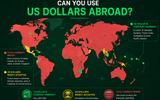
US Dollar
 Euro
Euro British Pound
 UAE Dirham
 Australian Dollar
 Singapore Dollar
The Highest Currency in the World, and Where the Dollar Actually Ranks

One Kuwaiti dinar costs about ₹311. One US dollar costs about ₹96. Put those side by side and the obvious conclusion is that Kuwait's economy must be more than three times as powerful as America's.
It is not. The United States economy is roughly a hundred times larger.
The highest currency in the world is a question about arithmetic, not about strength, and almost every list that answers it skips the part that matters. Seven of the top ten are not traded freely at all. Three of them are the British pound wearing a different design. And the dollar, the currency the whole system is priced against, is not in the top nine.
Here is the verified list for September 2026, what actually sets those rates, and the part that costs Indian buyers real money.

The highest currency in the world, ranked
These are the ten highest-value currencies by what one unit buys, on mid-market rates for 17 September 2026. Every figure was cross-checked against two independent rate feeds, which agreed to within 1 percent on all ten.
| Currency | Code | 1 unit in ₹ | 1 unit in USD | How the rate is set |
|---|---|---|---|---|
| 1. Kuwaiti dinar | KWD | 311.09 | 3.24 | Pegged to an undisclosed currency basket |
| 2. Bahraini dinar | BHD | 255.20 | 2.66 | Pegged to the US dollar |
| 3. Omani rial | OMR | 249.44 | 2.60 | Pegged to the US dollar |
| 4. Jordanian dinar | JOD | 135.34 | 1.41 | Pegged to the US dollar |
| 5. British pound | GBP | 129.08 | 1.35 | Floating |
| 6. Gibraltar pound | GIP | 129.08 | 1.35 | Pegged 1 to 1 with the pound |
| 7. Swiss franc | CHF | 116.93 | 1.22 | Floating |
| 8. Cayman Is. dollar | KYD | 115.26 | 1.20 | Pegged to the US dollar |
| 9. Euro | EUR | 110.57 | 1.15 | Floating |
| 10. US dollar | USD | 95.96 | 1.00 | Floating, the benchmark others are priced against |
Mid-market rates, 17 September 2026, rounded. The US dollar bought about ₹95.96 that day. Rates move daily, so treat this as a snapshot rather than a price. The Reserve Bank of India publishes its own daily reference rates for the major pairs.
Count the last column. Seven of the ten are pegged, which means a committee sets the number rather than a market discovering it.
Why the top four are all Middle Eastern
The Kuwaiti dinar, the Bahraini dinar, the Omani rial and the Jordanian dinar occupy the top four places, and none of them got there by appreciating.
Each one was simply introduced at a high value and held there. You can see the pegs in the raw data. Both rate feeds return the Bahraini dinar at exactly 0.376 to the dollar and the Jordanian dinar at exactly 0.709, to six decimal places, on the same day. Floating currencies do not do that. Those are administered numbers.
Kuwait is the interesting exception. The Central Bank of Kuwait moved the dinar off a straight dollar peg on 20 May 2007 and re-pegged it to an undisclosed weighted basket of its major trading partners' currencies. The composition has never been published. The bank's own exchange rate policy page still describes the basket arrangement today.
There is an Indian footnote to all this that most people find surprising. Before 1961, Kuwait used the Gulf rupee, a currency issued by the Reserve Bank of India for circulation outside India. The dinar replaced it. We covered that history and the four reasons the dinar sits where it does in why the Kuwaiti dinar is the world's strongest currency, so this article will not repeat it.
Oil surpluses and small populations keep these pegs credible. They are not what created the high numbers.

The currencies that pad out every top 10 list
Look at ranks 5 and 6 in the table. The British pound and the Gibraltar pound carry exactly the same value, because the Gibraltar pound is pegged one to one with sterling.
It is not alone. The Falkland Islands pound and the Saint Helena pound are also pegged one to one, so on 17 September all four sat at ₹129.08. A list that counts them separately can fill four of its ten places with what is effectively one currency. It is the main reason two rankings of the world highest currency can disagree about places five through ten.
The Cayman Islands dollar at rank 8 is a similar case, pegged to the US dollar at a fixed rate.
This matters for a practical reason rather than a pedantic one. You cannot walk into an authorised dealer in India and buy Gibraltar pounds, Falkland Islands pounds, Saint Helena pounds or Cayman Islands dollars. They are local issues for small territories, they are not carried by Indian dealers, and several are difficult to exchange even in London. If you are reading a top ten to work out what to carry on a trip, half of it is decoration.
The currencies on that list you can actually buy in India are the Kuwaiti dinar, the Bahraini dinar, the Omani rial, the Jordanian dinar, the pound, the Swiss franc, the euro and the dollar.
Where the US dollar actually ranks
Ninth or tenth, depending on how you count the pegged territory pounds.
That surprises people, and it exposes the confusion sitting under this whole question. Three different things get called "the strongest currency" and they are not the same thing at all.
Highest unit value is what this article ranks. It measures how much one unit buys, and it is largely an accident of what a country chose to call one unit when it issued the currency.
Most traded is a different list, and the dollar wins it outright. It is on one side of the overwhelming majority of global foreign exchange transactions, and it is what oil, metals and most international debt are priced in. Every currency in the table above except the euro and the pound is measured against it.
Most stable is a third list again, and it usually starts with the Swiss franc, which sits seventh here.
So the dollar is not the highest currency in the world and never has been. It is the most important one. If you want the mechanics of why any of these rates move day to day, we wrote that up separately in why the exchange rate changes every day. And at the far end of the same scale, the lowest currency in the world explains why a currency with six-figure numbers is not a poor country.

What a high unit value costs you at the counter
Here is the part that has nothing to do with trivia.
When a currency is worth ₹311 a unit, you buy very few units, and small orders stop looking like large amounts of money. KWD 500 sounds modest. It is ₹1.55 lakh.
That mismatch is where people stop checking the rate.
Take a worked example. On 17 September the mid-market rate was ₹311.09 to the dinar, so KWD 500 came to ₹155,545. Suppose a dealer quotes you ₹317 instead, which puts the same 500 dinars at ₹158,500.
| KWD 500 | Amount |
|---|---|
| At mid-market | ₹155,545 |
| At ₹317 quoted | ₹158,500 |
| Difference | ₹2,955 |
| As a spread | 1.9% |
The mid-market rate is indicative and moves daily. The ₹317 figure is an illustration, not a quote from any particular dealer. The point is the arithmetic, not the number.
Six rupees a dinar sounds like nothing. On a single order it is ₹2,955, which is most of a domestic flight. The same trap runs through the whole top of this list, because Bahraini dinars, Omani rials and Jordanian dinars all behave the same way.
The defence is simple and it takes a minute. Look up the mid-market rate on the day, then compare it against what you are quoted, before you pay rather than after.
Buying or sending Gulf currency from India
The top of this list is not abstract for Indian readers. It is the Gulf, and the Gulf is where a very large number of Indian families work, travel and send money.
A few practical points if you are buying.
Order before you travel, not at the airport. Airport counters quote the widest spreads of any channel in the country, and high-value currencies hide that spread well for the reason set out above. We went through the pattern in the airport forex counter trap.
Carry the right paperwork. Buying foreign currency in India needs your passport, your ticket or travel confirmation and a PAN for larger amounts. The full list is in documents needed for a forex purchase.
Most trips will not attract TCS. Tax Collected at Source applies above a ₹10 lakh threshold per financial year for general travel spending under the Liberalised Remittance Scheme. A KWD 500 order at ₹1.55 lakh is far below that, so it attracts none. The thresholds and the exceptions are set out in TCS on forex under LRS.
Know the cash limit. There are separate RBI limits on how much foreign currency you can carry as notes, covered in RBI rules on carrying foreign currency abroad.
For live rates on the currencies at the top of this list, the individual pages go straight to the number: KWD to INR, BHD to INR, OMR to INR, QAR to INR, SAR to INR and AED to INR.
If you are sending money rather than carrying it, the corridor pages for Kuwait and Saudi Arabia cover the documentation and the purpose codes.
Common mistakes people make with this list
Reading unit value as economic strength. Kuwait's dinar is worth more than the dollar. Kuwait's economy is a rounding error next to America's. The two facts are unrelated, and this is the misreading the entire article exists to correct.
Assuming a high value means an expensive country. It says nothing about local prices. What a week costs depends on what things cost there, not on how the currency is denominated.
Counting the same currency four times. Any list with Gibraltar, the Falklands and Saint Helena as separate entries is padding. They are all the pound.
Treating a pegged rate as a market rate. Seven of the top ten are administered. They can be changed by decision, and pegs have been reset before.
Not checking the rupee rate on a small-sounding order. A few hundred dinars is lakhs of rupees. This is the one that actually costs money.
Trusting a list with no date on it. These rates move daily and pegs get revised. A ranking that does not say when it was compiled is not evidence of anything.

Before you buy any of these
The currencies at the top of this list share one practical feature. Because each unit is expensive, you buy few of them, and an order that sounds small carries a large rupee value. That is exactly the situation where a rate is worth checking.
Matrix Forex is an RBI-authorised Authorised Dealer Category-II, licence NDL-ADII-0023-2023. You can see the rate for Kuwaiti dinars, Bahraini dinars, Omani rials, Saudi riyals, UAE dirhams and the rest on the currency converter before you commit to anything, order through buy forex for doorstep delivery or branch collection, and check exactly what our licence permits on the regulations page.
Frequently asked questions
Which is the highest currency in the world?
The Kuwaiti dinar. On 17 September 2026 one dinar was worth about 3.24 US dollars, or about ₹311. It has held the top position for decades, and not because Kuwait's economy is the world's strongest. The dinar was introduced at a high value in 1961 and has been held there ever since, currently by a peg to an undisclosed basket of currencies managed by the Central Bank of Kuwait.
Why is the Kuwaiti dinar the highest currency in the world?
Because it was issued at a high value and the peg has kept it there. When Kuwait replaced the Gulf rupee in 1961, the new dinar was set equal to one pound sterling, which was a high starting point. Oil revenue and a small population have made the peg easy to defend since. The Central Bank of Kuwait moved from a straight dollar peg to an undisclosed currency basket on 20 May 2007, and that arrangement still stands.
Which country has the highest currency?
Kuwait, followed by Bahrain, Oman and Jordan. All four are in the Middle East and all four run pegged exchange rates rather than letting the market set the price. The first country on the list with a freely floating currency is the United Kingdom, in fifth place.
Is the US dollar the strongest currency in the world?
Not by unit value. The dollar ranks ninth or tenth on that measure, behind four Middle Eastern currencies, the pound, the Swiss franc and the euro. It is comfortably the most traded and most widely held currency in the world, and almost every other currency is priced against it, but those are different measurements. Highest, most traded and most stable are three separate lists.
What is the most expensive currency in the world?
The Kuwaiti dinar, at roughly ₹311 per unit as of September 2026. The Bahraini dinar at about ₹255 and the Omani rial at about ₹249 follow it. Note that expensive here means one unit costs a lot, which is not the same as the country being expensive to visit or the economy being strong.
Can I buy Kuwaiti dinars or Omani rials in India?
Yes. Authorised dealers in India sell Kuwaiti dinars, Bahraini dinars, Omani rials, Saudi riyals, UAE dirhams and Qatari riyals as currency notes, subject to your Liberalised Remittance Scheme entitlement and the usual documents, which are your passport and travel confirmation plus a PAN for larger amounts. What you cannot buy in India are the pegged territory currencies that appear on these lists, such as the Gibraltar, Falkland Islands and Saint Helena pounds.
Same-day delivery · RBI-authorised · No hidden charges
Get Free Callback →More from the Blog