US Dollar
 Euro
Euro British Pound
 UAE Dirham
 Australian Dollar
 Singapore Dollar
Forex Card for Students Going Abroad: What to Load, What It Costs, and When to Switch to a Local Bank Account

The flight is booked, the visa is stamped and the tuition has gone by wire. Now there is a smaller, more personal question: how will you actually pay for things in the first weeks? Groceries, a SIM card, a bus pass, the deposit on a room.
For most Indian students, the answer is a forex card for students: a prepaid card loaded in India with the currency of the country you are going to. It is the right tool for the first few months. It is not the right tool for the whole degree.
This guide covers how much to load, the charges that matter on a student card, the RBI limits, and the moment to hand over to a local bank account in the US, UK, Canada, Australia or Germany. That last part is the step most guides skip.

What Is a Forex Card for Students?
A forex card is a prepaid card you load in India with foreign currency at a rate fixed on the day you load it. You spend it abroad like a debit card, and it draws from the balance in that currency.
A student forex card is the same product, often with student extras such as an ISIC student ID or a cheaper reload. The core idea is identical: you convert rupees before you travel, so a weakening rupee does not change what you have already loaded, and you avoid the foreign transaction markup, often up to 3.5% plus GST, that many Indian debit and credit cards charge on every foreign spend.
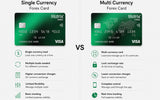
Matrix Forex's card holds up to 28 currencies in separate wallets on one card. That matters for students who start in one country and travel during breaks.
How Much to Load on a Student Forex Card
Load enough for your first two to three months of living costs, plus a buffer for deposits. Do not load the whole year.
A practical way to size it is to use the living-cost figure your visa already asks you to show. For the UK, GOV.UK sets it at £1,529 a month in London and £1,171 a month elsewhere.
| UK student, outside London | Amount |
|---|---|
| Monthly living cost used for the visa | £1,171 |
| Three months to load | £3,513 |
| In rupees at a card rate of ₹127.62 | ₹4,48,329 |
| GST on the currency conversion | about ₹493 |
Rates: Matrix Forex live GBP card rate, 6 October 2026, 11:32 AM IST. Living-cost figure: GOV.UK student visa money guidance.
Why not more? Because once your local bank account is open, your monthly money will usually travel more cheaply by wire to that account, rent may need a local direct debit, and a large unused balance on a card earns nothing. Why not less? Because you will pay a deposit and the first month's rent before your local account works, and the first weeks always cost more than a normal month.
Carry some cash too. RBI lets a student take up to USD 3,000 or its equivalent in notes, which is enough for the airport, a taxi and the first few days.
The RBI and Tax Rules on Student Forex
- How much you can take. Under RBI's Liberalised Remittance Scheme, a dealer can release up to USD 250,000 a financial year for studies abroad on your own declaration, and more against the university's cost estimate. Your forex card, cash and tuition wires all count towards that total. Our RBI rules guide covers the cash limits in detail.
- TCS. Education remittances above ₹10 lakh in a financial year attract 2% TCS from 1 April 2026, or nothing if funded by an education loan from a qualifying financial institution. Tuition often uses up the ₹10 lakh threshold, so a card load made after the fees may attract 2% from the first rupee. It is credited against your income tax. Our TCS guide has every category.
- Documents. Expect your passport, visa, admission letter, PAN and the A2 form. The forex document checklist lists them by purpose.
Student Forex Card Charges: What Actually Costs You Money
The rate you load at is the biggest cost, and you see it before you pay. The other charges are small individually and add up over a year.
| Charge | What it is | Example from a bank student card |
|---|---|---|
| Load rate | The rupee price of each unit of currency you load | Compare the rate, not the fee line |
| Issuance fee | One-time fee for the card | ₹300 plus GST |
| Reload fee | Charged per top-up | ₹75 plus GST per reload, free online |
| ATM withdrawal fee | Charged by the card per cash withdrawal | USD 2, EUR 1.50 or GBP 1 each time |
| Cross-currency fee | Spending in a currency you have not loaded | 3% to 3.5% plus GST |
| GST on conversion | Charged on the rupee value of each load | ₹45 to ₹10,800, on a slab |
Example fees: HDFC Bank's ISIC Student ForexPlus card fee schedule, and ICICI Bank's forex card schedule of charges for the 3.5% cross-currency figure. Each issuer sets its own fees, so check yours before loading.
Three of these deserve attention:
- The cross-currency fee. If your card holds pounds and you spend in euros on a weekend trip to Paris, the card converts at a markup. Load every currency on your route, or use a multi-currency card. Our guide to the cross-currency fee explains it.
- ATM fees. They are charged per withdrawal, so take out larger amounts less often. The local ATM operator may add its own fee on top.
- The "pay in INR" button. Card machines and ATMs abroad sometimes offer to charge you in rupees. Always choose the local currency. Our guide to dynamic currency conversion shows what that button costs.
When to Switch to a Local Bank Account
The forex card carries you through arrival. A local bank account should take over your day-to-day money within your first month or two. Here is when each country lets you open one.
| Country | When you can open an account | What you usually need |
|---|---|---|
| United States | Usually after you arrive | Passport, F-1 visa, I-20, I-94 and a US address. Many banks open student accounts without a Social Security Number. |
| United Kingdom | Usually after you arrive | Passport, eVisa share code, a university letter or CAS, and proof of a UK address |
| Canada | Often already open | Your GIC bank account becomes your Canadian account, and the first payout arrives after you land |
| Australia | Up to 14 days before arrival with Commonwealth Bank | Apply online, then visit a branch with your passport after you land |
| Germany | After you register your address | A current account (Girokonto) is needed to receive your blocked account payouts |
Sources: university and bank guidance for US F-1 students; UKCISA on eVisas, since physical BRP cards have been replaced by eVisas; Commonwealth Bank's international student checklist; our guides to the Canada GIC and the German blocked account.
Switch once any of these happens:
- Your rent needs a local direct debit or bank transfer. Most landlords and university halls will not take a foreign prepaid card for recurring rent.
- You start part-time work. Employers pay wages into a local account.
- Your monthly support from home becomes regular. A wire from India to your own local account suits larger fixed monthly amounts better than repeated card reloads. Our parents' guide to sending money to a child studying abroad and the recurring remittance guide compare the two.
- You need a local card for everyday spending. Some services, subscriptions and phone contracts ask for a local card.
What the forex card is still good for
Do not close it when the local account opens. Keep it for:
- Travel during breaks. A multi-currency card with euros or other currencies loaded avoids cross-currency fees on a trip to another country.
- A backup. If your local card is lost or blocked, a second card in a different wallet keeps you going.
- Emergency top-ups from home. Parents can reload it from India without anyone visiting a branch abroad.
When you come home for good, encash the balance back to rupees rather than leaving it idle.

Forex Card or Local Account? A Quick Comparison
| Student forex card | Local bank account | |
|---|---|---|
| Works from day one | Yes, loaded before you fly | No, opens after arrival in most countries |
| Exchange rate | Fixed when you load | Set by the wire you send from India |
| Rent and direct debits | Usually not accepted | Yes |
| Receiving wages | No | Yes |
| Spending in other currencies | Good, if those currencies are loaded | Your local bank's foreign fee applies |
| Best for | Arrival, travel, backup | Daily life after the first month |
Common Mistakes Students Make With Forex Cards
Loading the whole year at once. It ties up money you cannot use for rent or local payments, and a large idle balance is a bigger loss if the card is compromised.
Spending in a currency you did not load. A weekend in another country can cost 3% to 3.5% extra on every purchase.
Withdrawing small amounts of cash often. Each ATM withdrawal carries a fixed fee. Fewer, larger withdrawals cost less.
Pressing "pay in INR". That is dynamic currency conversion, and it adds a markup on top of everything else.
Using an Indian debit card for daily spending. Many charge a foreign transaction markup of up to 3.5% plus GST on every purchase. Our comparison of forex card vs international debit card shows the difference.
Closing the card once the local account opens. Keep it as a travel card and a backup, with a small balance.
Frequently Asked Questions
What is a forex card for students?
A forex card for students is a prepaid card loaded in India with foreign currency, such as US dollars or British pounds, at a rate fixed on the day of loading. Students use it abroad like a debit card for living costs, especially in the first months before a local bank account is open. Some student cards add extras such as an ISIC student ID.
How much money should a student load on a forex card?
Load enough for the first two to three months of living costs, plus a buffer for deposits. For a UK student outside London, three months at the visa living-cost figure of £1,171 a month is £3,513, about ₹4.48 lakh at a card rate of ₹127.62 on 6 October 2026. Send later monthly money to a local bank account.
Which is the best forex card for students?
The best forex card for students is the one with a competitive load rate, low or no reload fees, and wallets in every currency you will spend, including countries you may visit during breaks. Compare the total rupee cost of loading a fixed amount, then check ATM, cross-currency and reload fees, rather than choosing on the issuance fee alone.
What charges apply on a student forex card?
The main charges are the load rate, an issuance fee, a reload fee, an ATM withdrawal fee per cash withdrawal, a cross-currency fee of about 3% to 3.5% when you spend a currency you have not loaded, and GST on the rupee value of each load. HDFC's ISIC student card, for example, lists ₹300 plus GST for issuance and USD 2 per ATM withdrawal.
When should a student open a local bank account abroad?
Open a local bank account in the first month or two, once you have an address and your university documents. Switch your daily money to it when rent needs a local payment, you start part-time work, or monthly support from home becomes regular. Keep the forex card for travel and as a backup.
Can a student open a US bank account without a Social Security Number?
Yes, at many banks. F-1 students are often able to open a student checking account with a passport, F-1 visa, Form I-20, I-94 record and proof of a US address, without a Social Security Number. Requirements vary by bank, so check before your first branch visit.
How much foreign currency can a student take from India?
Under RBI's Liberalised Remittance Scheme, a student can be given up to USD 250,000 a financial year for studies abroad on self-declaration, and more against the university's cost estimate. Up to USD 3,000 or its equivalent can be carried as cash. Forex card loads, cash and tuition wires all count towards the limit.
Get Your Student Forex Card Before You Fly
Matrix Forex is an RBI-authorised Authorised Dealer Category-II (licence NDL-ADII-0023-2023). We load forex cards in up to 28 currencies at the live card rate, with documents handled digitally, and our student remittance team sends tuition and monthly money to your university or your new local account. Load the first months on the card, open your local account when you land, and let each do the job it is best at.
Same-day delivery · RBI-authorised · No hidden charges
Get Free Callback →More from the Blog