 US Dollar
 Euro
Euro British Pound
 UAE Dirham
 Australian Dollar
 Singapore Dollar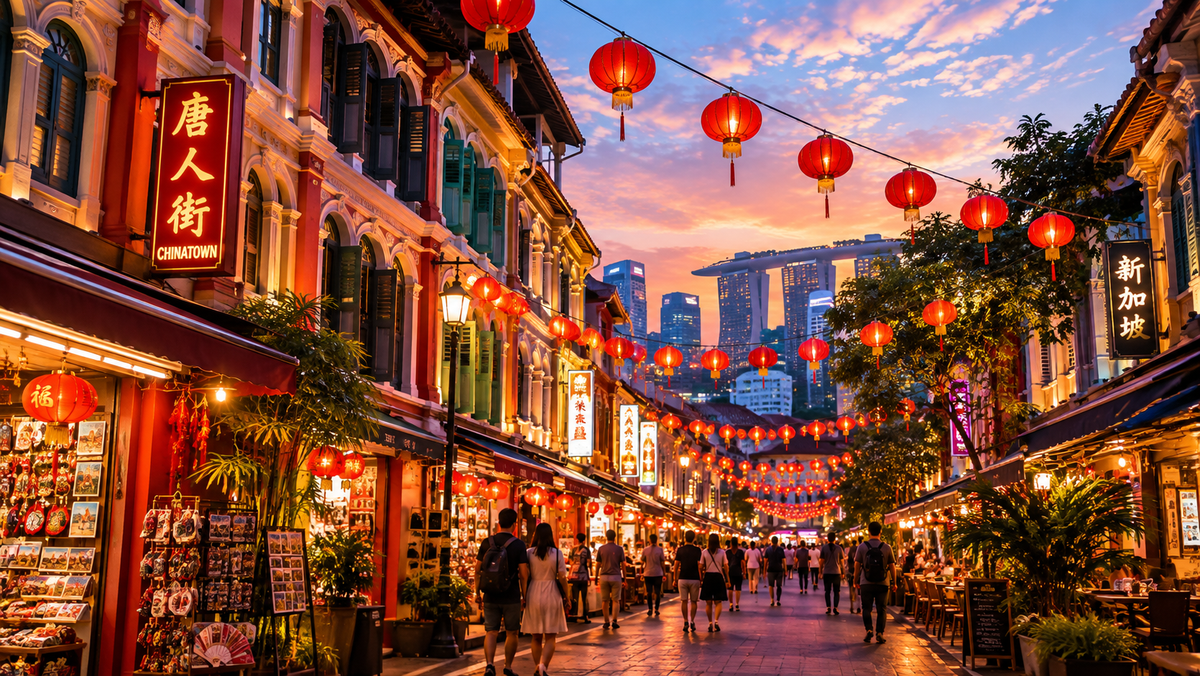
Chinatown Travel Guide
Buy Singapore DollarsChinatown at a glance
Chinatown is where Singapore's efficiency slows down a little. Shophouses instead of towers, temples instead of malls, and some of the cheapest, best food in the entire city sitting a few steps from where you get off the MRT. It's also proof that Singapore's near-cashless reputation has exceptions, mostly right here. The district predates modern Singapore by a long way, this was one of the original ethnic quarters carved out under colonial urban planning, and unlike some of the city's more polished historic districts, Chinatown still functions as a working neighbourhood rather than a preserved museum piece: people live above the shophouses, the temples hold real daily worship, and the hawker centres feed locals as much as tourists.
Chinatown MRT station sits right at the centre of the district, served by both the Downtown Line (blue) and North East Line (purple), Exit A puts you directly at Pagoda Street and the street market. It's about 10 minutes from Marina Bay by MRT and 5 minutes from Clarke Quay, making it an easy add-on rather than a dedicated separate trip.
A single MRT ride runs S$1-2, tapped on EZ-Link, SimplyGo, or a contactless card directly at the gate. For the general MRT and transit-card setup that applies across Singapore, see the Singapore money guide.
Midday: Buddha Tooth Relic Temple and Sri Mariamman Temple, both a few minutes apart on South Bridge Road. Lunch: Maxwell Food Centre or Chinatown Complex. Afternoon: wander Pagoda Street and Trengganu Street, the Chinatown Heritage Centre if history interests you. Evening: Ann Siang Hill or Club Street for drinks and dinner if you're staying past dark.
What to see and do
The highlights in Chinatown, and which of them cost anything.
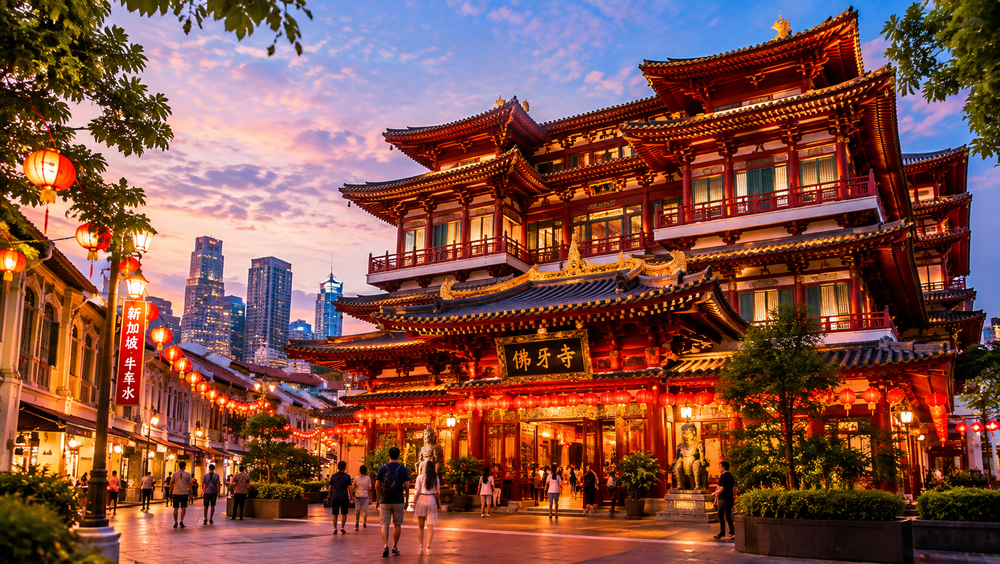
Buddha Tooth Relic Temple
a five-storey Tang Dynasty-style temple on South Bridge Road, free entry, home to what's believed to be a tooth relic of the Buddha, displayed in a gold stupa on the fourth floor. The building itself is worth the visit independent of the relic, a striking combination of Buddhist mandala design and T
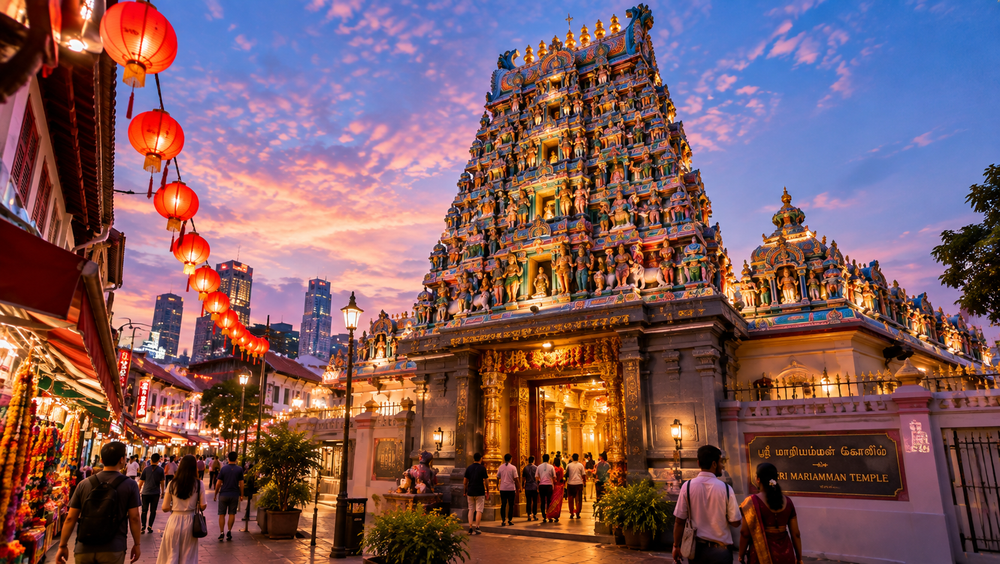
Sri Mariamman Temple
Singapore's oldest Hindu temple, built in 1827, right next door to the Buddhist temple, dedicated to the goddess Mariamman. Free to enter, remove shoes before stepping onto the temple grounds, and dress modestly, shoulders and knees covered. The colourful, intricately carved gopuram entrance tower i
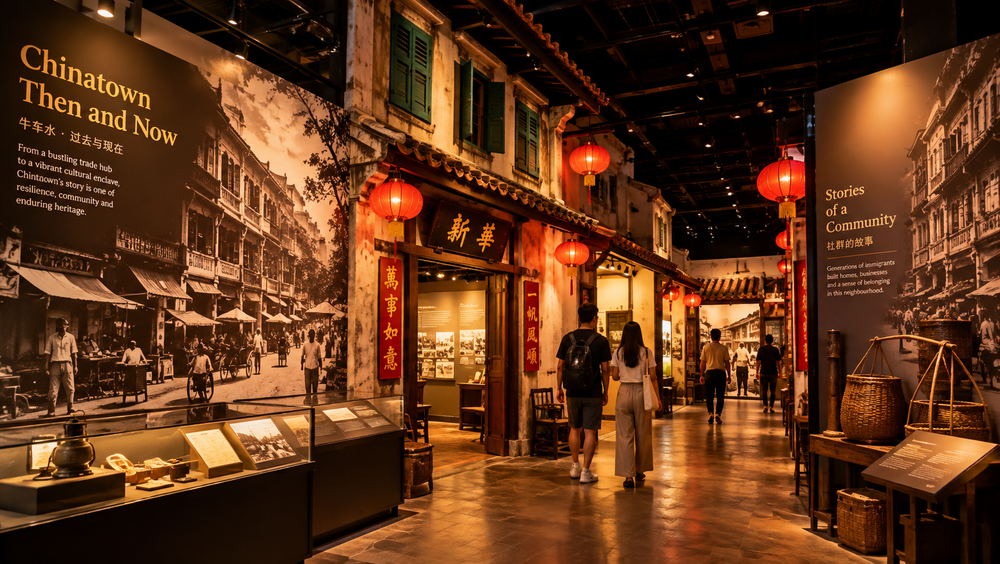
Chinatown Heritage Centre
exhibits on the lives of early Chinese immigrants to Singapore, housed in restored shophouses that recreate the cramped living conditions of the early 20th century. Note this one is a paid museum, not free, roughly S$15-18, but worth including here as the natural next stop after the free temples if
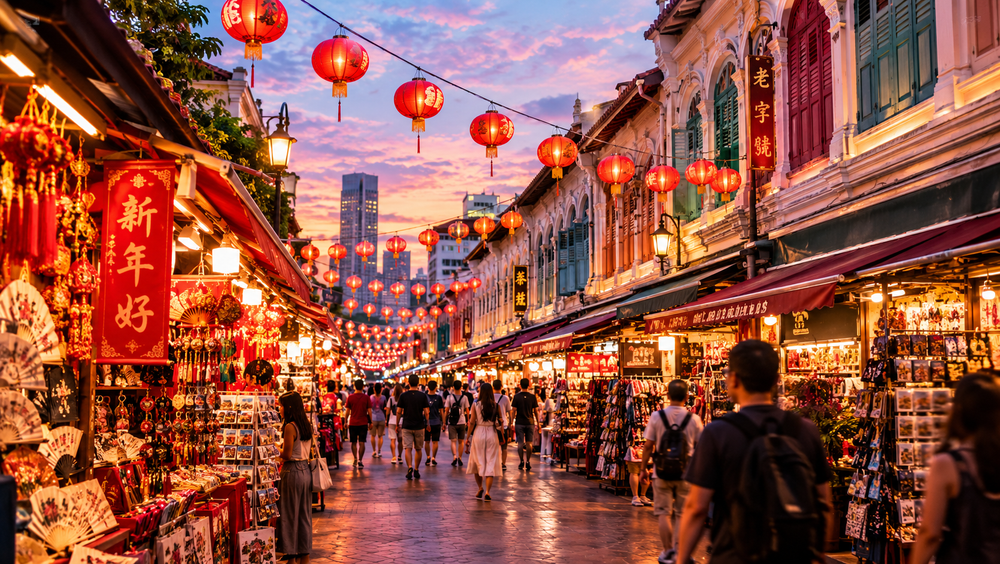
The street market and shophouse streets
Pagoda Street, Trengganu Street, and Smith Street, lined with souvenir stalls, lanterns, and restored shophouse facades, free to wander at any hour, most vivid in the evening when the lanterns are lit. Smith Street in particular used to be known as Chinatown Food Street and still carries some of tha
Paying in Chinatown
Chinatown is more cash-friendly than most of Singapore, not because cards don't work, but because some of the older hawker stalls and smaller shophouse shops still prefer cash, and a few genuinely don't take cards at all. This is one of the few pockets of the city where carrying a modest amount of SGD cash noticeably smooths the day, especially at the hawker centres, where paying cash avoids any minimum-spend friction some stalls apply to card payments.
Licensed money changers in People's Park Complex, a short walk from Chinatown MRT, are one of the better places in Singapore to top up cash mid-trip, often at rates close to the interbank rate and better than what a hotel front desk or the Changi Airport counters offer. If you're running low on SGD partway through a longer Singapore trip, this is genuinely one of the cheaper places in the city to fix that, rather than a compromise you make for convenience.
For the currency basics, the LRS and TCS numbers, and where to buy Singapore dollars before flying, see the Singapore travel guide.
Before you fly it is worth reading how to spot a genuine Singapore dollar note.
Getting here
Chinatown MRT station sits right at the centre of the district, served by both the Downtown Line (blue) and North East Line (purple), Exit A puts you directly at Pagoda Street and the street market. It's about 10 minutes from Marina Bay by MRT and 5 minutes from Clarke Quay, making it an easy add-on rather than a dedicated separate trip.
A single MRT ride runs S$1-2, tapped on EZ-Link, SimplyGo, or a contactless card directly at the gate. For the general MRT and transit-card setup that applies across Singapore, see the Singapore money guide.
The core of Chinatown, Pagoda Street, Trengganu Street, Smith Street, and the temple cluster around South Bridge Road, is entirely walkable and pedestrianised in the centre, so once you're off the MRT there's no need for further transit until you're heading elsewhere. If your day also includes Little India or Kampong Glam, all three sit on connecting MRT lines, so stitching them into a single day is straightforward rather than requiring separate trips back to your hotel in between.
Common mistakes in Chinatown
Skipping shoes-off etiquette at the temples
Skipping shoes-off etiquette at the temples. Both major temples require it in specific areas, the Buddha Tooth Relic Temple's fourth-floor relic chamber and the Sri Mariamman Temple grounds generally, and it's enforced.
Assuming every hawker stall takes cards
Assuming every hawker stall takes cards. Many do now, but Chinatown has more cash-only holdouts than Marina Bay or Orchard Road, carry some SGD specifically for this district.
Skipping the wet market floor at Chinatown Complex for the hawker floo
Skipping the wet market floor at Chinatown Complex for the hawker floor alone. The market level below is one of the more photogenic, less touristy parts of the whole quarter.
Visiting only during the day and missing the Ann Siang Hill and Club S
Visiting only during the day and missing the Ann Siang Hill and Club Street evening scene entirely, the same streets look and feel completely different after dark.
Not budgeting queue time for Hawker Chan or other Michelin-recognised
Not budgeting queue time for Hawker Chan or other Michelin-recognised stalls. The food is fast once you're served, but the queue itself can run 20-30 minutes at peak lunch hours.
Chinatown FAQs
Yes, it's less a shopping district and more a genuine temple-and-hawker neighbourhood, and the food alone, particularly the Michelin-recognised stalls, makes it worth the stop regardless of other Chinatowns you've seen.
More than in most of Singapore. Carry a modest amount of SGD for hawker stalls and smaller shophouse shops, though most places do also take cards now.
S$3-6 for a plate at most stalls, among the cheapest proper meals in the city for the quality.
Yes, entirely free. Donations are welcome but not required. Photography is restricted in the relic chamber on the fourth floor.
Yes, easily, they're a few MRT stops apart on connecting lines, and many visitors do exactly this for a half-day cultural loop covering both.
Modest clothing, shoulders and knees covered, is expected at both major temples. Shoes come off in specific areas, the relic chamber at the Buddhist temple and the grounds of the Hindu temple.
People's Park Complex, a short walk from Chinatown MRT, has several licensed money changers offering rates close to the interbank rate, generally better than a hotel or the airport.
Yes, Singapore as a whole is very safe, and Chinatown's evening bar-and-dining district on Ann Siang Hill and Club Street is well-lit and busy well into the night.
Buy singapore dollar before you fly
See your Matrix rate and the applicable charges before you confirm. Order online for doorstep delivery or collect from your nearest branch.
RBI Authorised Dealer Category-II, Licence No. NDL-ADII-0023-2023 · Same-day delivery · Serving 3 lakh+ customers